
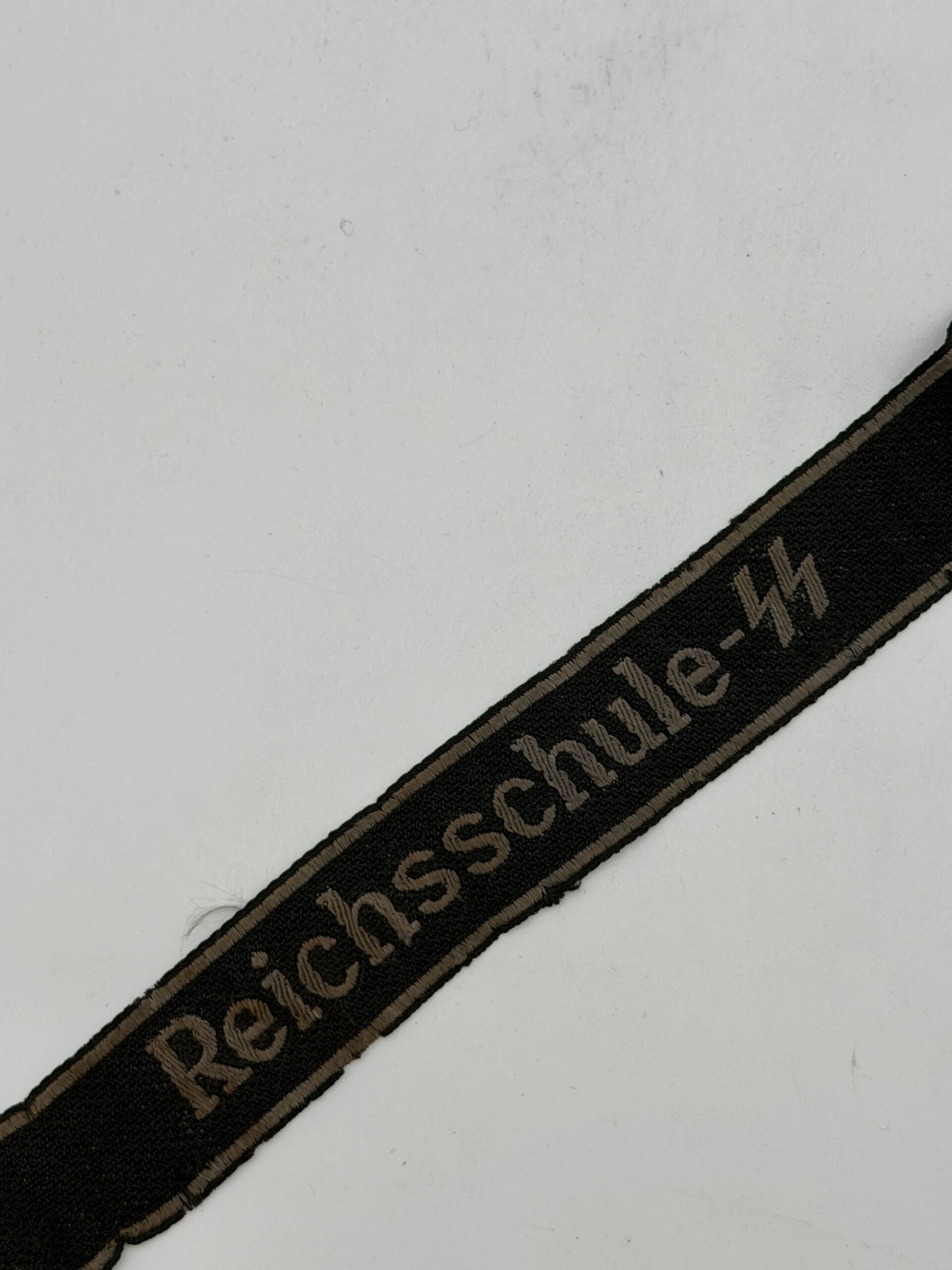
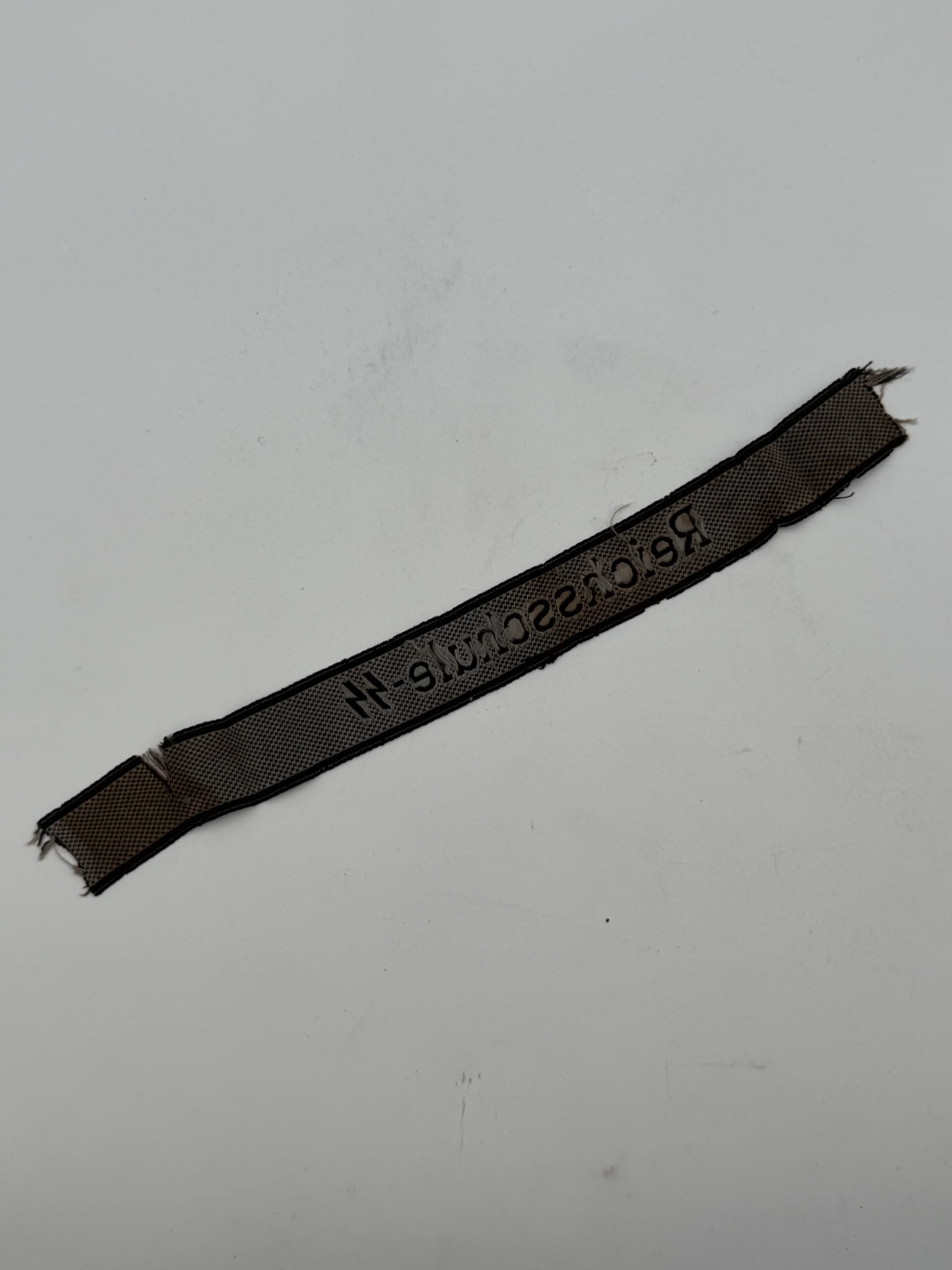
Rare original Reichsschule-SS cuff title associated with the SS-Helferinnen training school at Oberehnheim in Alsace. Produced in BeVo-type flatwoven construction with matt silver-grey lettering, woven borders and SS runes on a black rayon ground. This tunic-removed example measures 30 cm and retains the complete inscription, characteristic reverse weave and convincing period wear.
€ 1.400
1 in stock
This original Reichsschule-SS cuff title is a rare uniform insignia associated with the Reichsschule-SS at Oberehnheim, now Obernai in Alsace. The school trained female SS auxiliaries, primarily for communications and administrative duties.
The title uses black BeVo-type woven material with matt silver-grey lettering and matching woven borders. Its complete inscription reads:
Reichsschule-SS
A pair of SS runes completes the designation. Moreover, the reverse displays the distinctive negative weave created during manufacture.
This example measures 30 cm. It was removed from a tunic and consequently no longer retains its original factory length. Both ends show cuts and fraying. In addition, one end has a substantial near-transverse cut associated with removal. Nevertheless, the central inscription remains complete, clear and highly presentable.
The SS established the school at Oberehnheim in Alsace during 1942. It initially operated as the SS-Nachrichtenschule (WNK) Oberehnheim, or female communications school.
The institution then underwent several official name changes:
These changes appear in the surviving school records and in Jutta Mühlenberg’s detailed archival study of the SS-Helferinnenkorps.
The principal surviving records form Bundesarchiv collection NS 32 II. They cover the school’s organisation, personnel, recruitment, training, discipline and wartime evacuation. The records also show that the school initially answered to the SS Chief of Telecommunications. In 1944, responsibility shifted to the SS Main Office.
The EHRI description of Bundesarchiv collection NS 32 II provides an authoritative introduction to the surviving archive. The Deutsche Digitale Bibliothek record for the Reichsschule also identifies original files concerning the school’s personnel and establishment.
The SS created the Helferinnenkorps to replace male communications personnel who were required for other wartime duties. Applicants underwent selection before entering the school.
Training concentrated primarily on:
Following the basic course, successful candidates took an oath and entered the SS-Helferinnenkorps. Surviving Bundesarchiv files document at least 2,375 women who became female members of the Waffen-SS organisational system.
A regulation dated 14 August 1943 formally distinguished trained SS-Helferinnen from other female employees described as Kriegshelferinnen. Modern scholarship identifies a surviving copy of this regulation in the Arolsen Archives under reference 1.1.29.0024/0100, document 82131142.
SS-Helferinnen served as telephonists, radio operators, teleprinter operators and clerical staff at SS offices throughout Germany and occupied Europe. Some worked within the administrative systems of concentration camps and SS security organisations. However, they should not automatically be confused with female concentration-camp guards, who formed a separate category with different training and duties.
The Auschwitz-Birkenau educational study of SS-Helferinnen provides further historical context concerning their training and service. The Topography of Terror study of the SS-Helferinnenkorps also introduces the principal modern research.
The Reichsschule-SS cuff title identified association with the specialist school and the trained SS-Helferinnen organisation. It was not the cuff title of a combat division or field regiment.
Period photographic evidence confirms its wear by female SS auxiliaries. A surviving group photograph catalogued by Ratisbon’s shows a group of SS-Helferinnen wearing the Reichsschule-SS title on their uniforms.
The Ratisbon’s SS-Helferinnen group photograph provides particularly useful visual evidence. It confirms that the title was not simply a theoretical uniform regulation but was actually worn by women connected with the school.
Male instructors and administrative personnel also served at the Reichsschule. Therefore, a loose title cannot establish the sex, name or exact appointment of its original wearer. Nevertheless, the title is most strongly associated in specialist references and period photography with the SS-Helferinnen school.
This title uses BeVo-type machine-woven construction. The word “BeVo” commonly describes the flatwoven insignia associated with the Bandfabrik Ewald Vorsteher in Wuppertal-Barmen. However, without a surviving manufacturer’s label, the name should describe the weaving style rather than guarantee one specific factory.
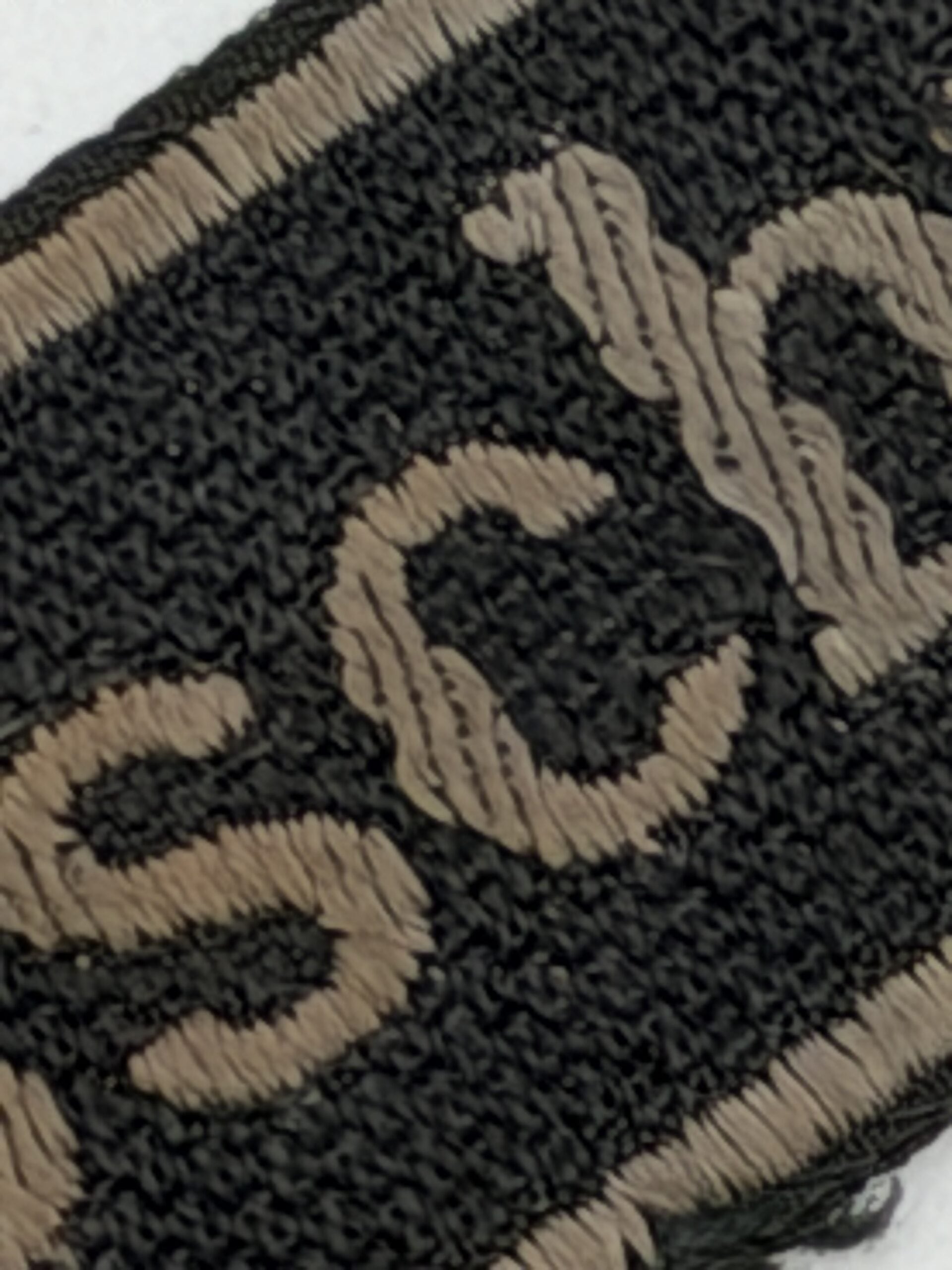
The inscription and borders form part of the woven structure. They were not embroidered onto a completed black band.
The front displays:
The grey thread has mellowed to a warm grey-beige shade. This variation appears consistent with age, handling, exposure and use. Furthermore, the colour remains coherent across the wording, runes and borders.
The lettering sits flat within the textile. It does not rise above the black ground like conventional machine embroidery. Therefore, this is correctly described as a flatwoven BeVo-type cuff title, rather than an RZM-pattern embroidered title.
The reverse provides important construction evidence.
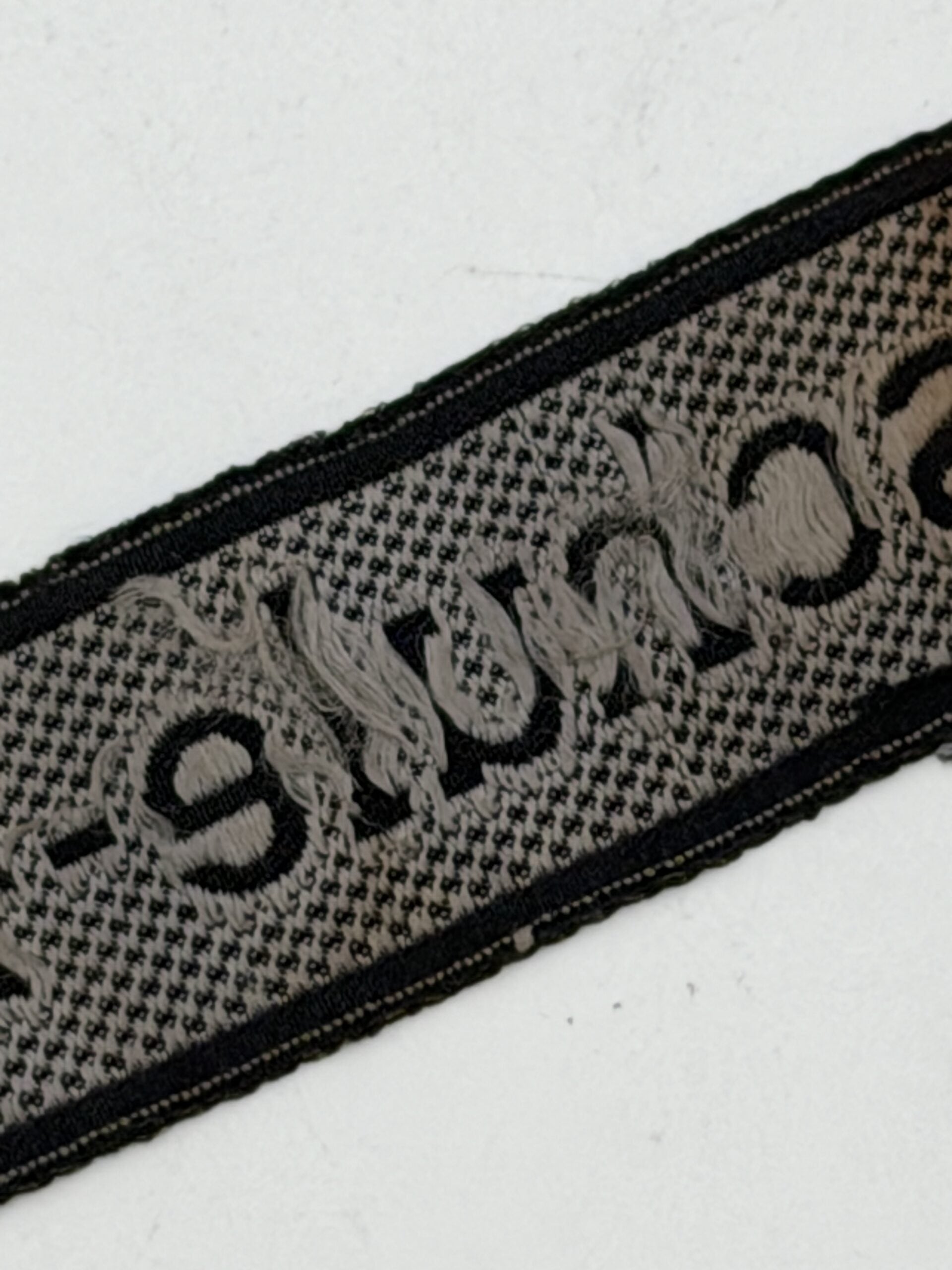
It shows the inscription in reversed negative form. The pale reverse field contains the black negative shapes of the letters and SS runes. This pattern resulted directly from the weaving process.
The reverse also displays the fine alternating black-and-grey structure often described by collectors as a “salt-and-pepper” weave. There is no separately applied backing strip and no visible modern adhesive.
The reverse construction corresponds with recognised original BeVo-woven examples. In addition, the front and reverse show compatible wear. No part appears to have been added recently.
This Reichsschule-SS cuff title measures 30 cm.
A complete unused title could measure approximately 48 cm. For example, the current Military Collectibles example measures 19 inches. Hermann Historica previously catalogued another worn title shortened for use to approximately 36 cm. Consequently, shortened examples are an established feature of surviving uniform-removed pieces.
Your title is significantly shorter than factory length. However, it retains:
Reichsschule;Both ends have been cut and show loose period fibres. One end also has a near-transverse cut extending through most of the width. This damage probably occurred during removal from the sleeve or during subsequent handling.
The cut should remain exactly as found. It forms part of the title’s surviving history. Therefore, the ends must not be glued, resewn, trimmed or heat sealed.
The black foundation remains dark, dense and structurally stable across the central section. Light rippling and compression reflect earlier uniform wear.
The full Reichsschule-SS inscription remains present. The letters and runes show minor surface wear, but no major element is missing.
Both woven borders remain visible throughout most of the surviving length. Small pulls, localised rubbing and slight discolouration appear along the edges.
The characteristic reversed BeVo weave remains clearly visible. There is no modern backing fabric or adhesive residue.
Both ends are cut and frayed. One end has a substantial near-transverse cut or tear. The other end also shows loose black and pale fibres.
No RZM paper label survives. This is unsurprising because the title has been shortened and removed from a tunic.
No obvious modern repair appears in the photographs. The existing cut and loose fibres remain untreated.
Good historic, tunic-removed condition. The cuff title has significant end damage and reduced length. However, the complete rare inscription remains attractive and fully displayable.
The visible construction supports an original pre-1945 assessment.
Positive features include:
The title also corresponds closely with the construction described on recognised dealer and auction examples. Hermann Historica described its 36 cm example as a black band with matt-grey woven Latin lettering and woven borders. A full-length dealer example uses the same black ground, silver-grey borders and machine-woven inscription.
The most accurate conclusion is:
Original period Reichsschule-SS cuff title in BeVo-type flatwoven construction, associated with the SS-Helferinnen training school at Oberehnheim. Measuring 30 cm, the title was removed from a tunic and retains the complete inscription, original woven borders and characteristic reverse structure.
The Reichsschule-SS cuff title belongs to a specialised and comparatively small field of female SS uniform insignia.
Unlike divisional titles produced for thousands of combat personnel, this designation related to a single specialist training institution and its female auxiliary organisation. The school existed for only a short period, while the Reichsschule-SSname itself was officially used from September 1943 until the institution’s later renaming in 1944.
Several qualities enhance this example:
The 30 cm length and damaged end reduce its value against a complete example. Nevertheless, the title remains a scarce and historically important piece suitable for an advanced SS cloth-insignia collection or a display devoted to women within the Nazi administrative and communications system.
| Feature | Description |
|---|---|
| Organisation | SS-Helferinnenkorps / Waffen-SS organisational system |
| Institution | Reichsschule-SS |
| Location | Oberehnheim, Alsace; now Obernai, France |
| Period | Circa 1943–1944 |
| Inscription | Reichsschule-SS |
| End device | Woven SS runes |
| Construction | BeVo-type machine-flatwoven construction |
| Foundation | Black woven rayon |
| Lettering | Matt silver-grey woven thread |
| Borders | Silver-grey flatwoven upper and lower borders |
| Reverse | Reversed negative or salt-and-pepper weave |
| Length | 30 cm |
| Condition | Tunic removed, shortened and worn |
| End condition | Both ends cut; near-transverse cut at one end |
| RZM label | Not present |
| Repairs | None apparent |
Explore related listings: militaria catalogue; Nordmenn Militaria Uniforms Collection; Original SS Items Collection; Original SS-Verfügungstruppe Deutschland BeVo Flatwoven Cuff Title.
These sources document the school’s history, archival holdings, women’s auxiliary training and photographic evidence of the title in wear.
It was the principal SS training school at Oberehnheim for female communications and administrative auxiliaries. The institution operated under several closely related names between 1942 and 1944.
Period photographs document the title on female SS-Helferinnen associated with the school. Male instructors and administrative staff also served there, so a loose cuff title cannot identify the original wearer’s sex or appointment with certainty.
No. It identified an SS school and auxiliary organisation rather than a combat division or regiment.
Yes. The lettering, runes and borders form part of the flatwoven structure. The reverse displays the expected negative weave. However, without a maker’s label, “BeVo-type” is safer than assigning it unconditionally to one factory.
A complete example could measure about 48 cm. This title was cut down when fitted to or removed from a tunic. Both ends retain visible removal damage.
Yes. The full wording Reichsschule-SS, including the SS runes, remains visible and legible.
No repair is visible. The cut appears to form part of the title’s removal damage. It should remain untreated.