
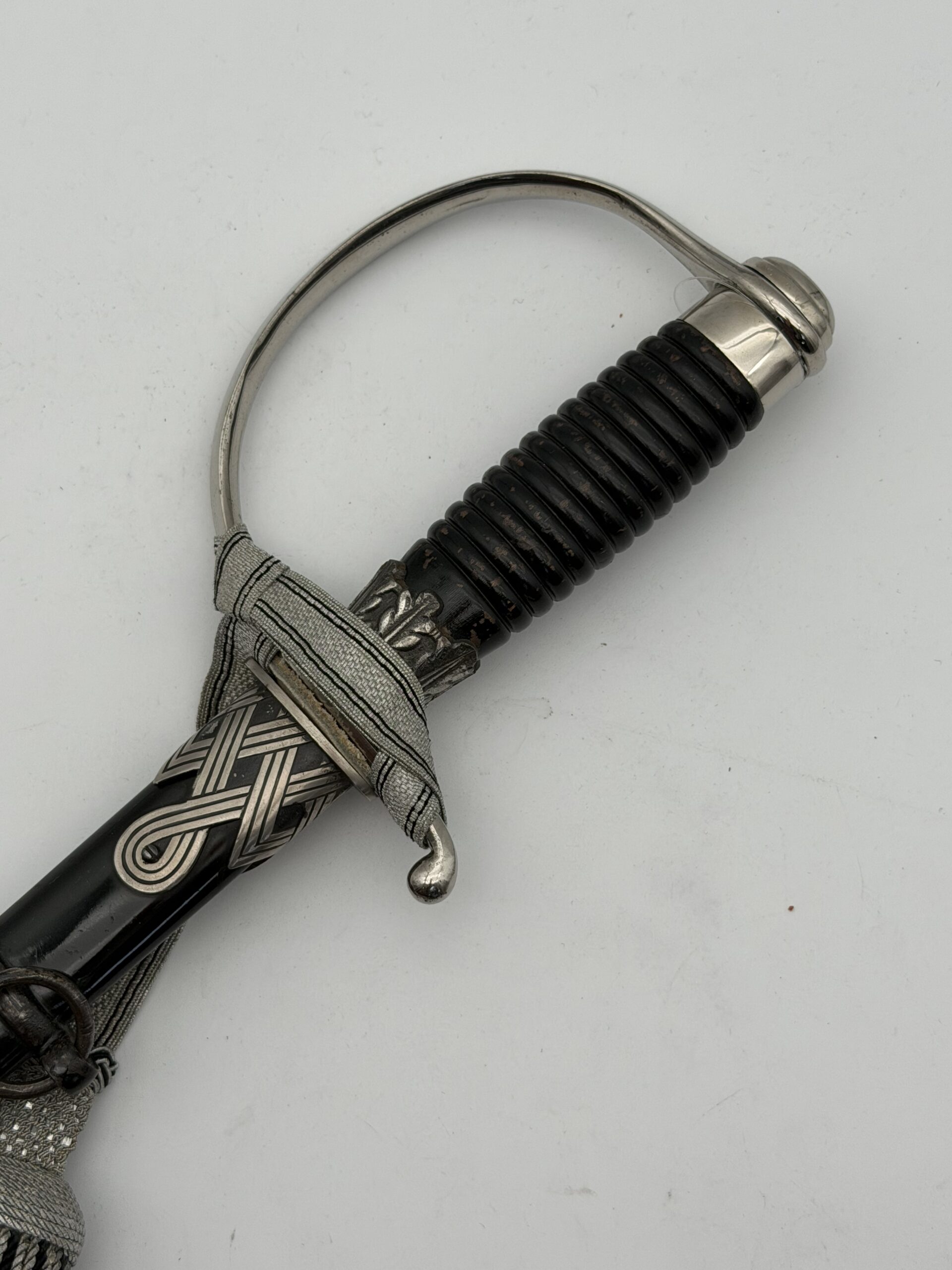
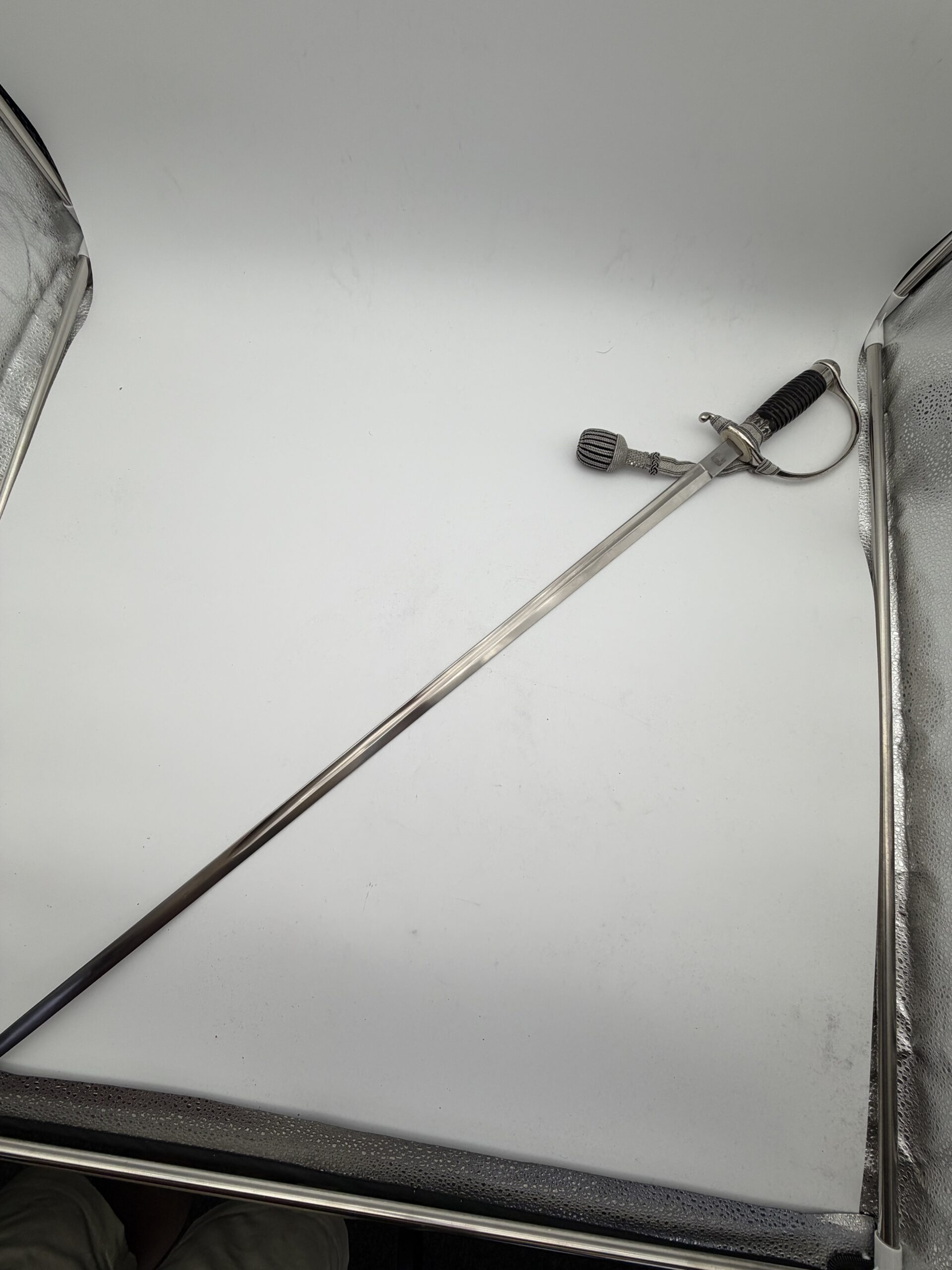
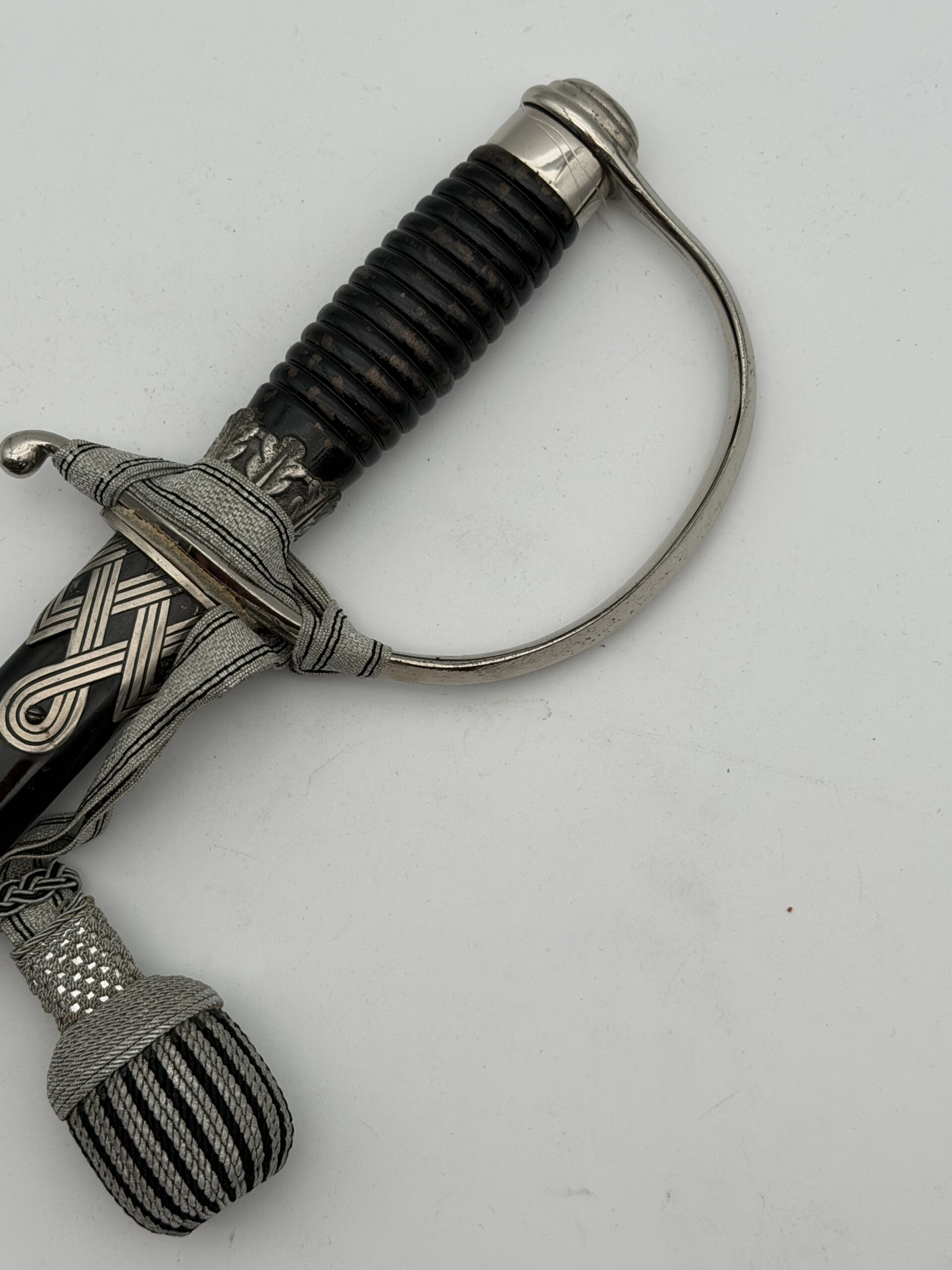
An exceptional, museum-standard SS Unterführerdegen by Peter Daniel Krebs, Solingen, preserved in remarkably strong original condition and complete with its correct SS portepee and black lacquered steel scabbard.
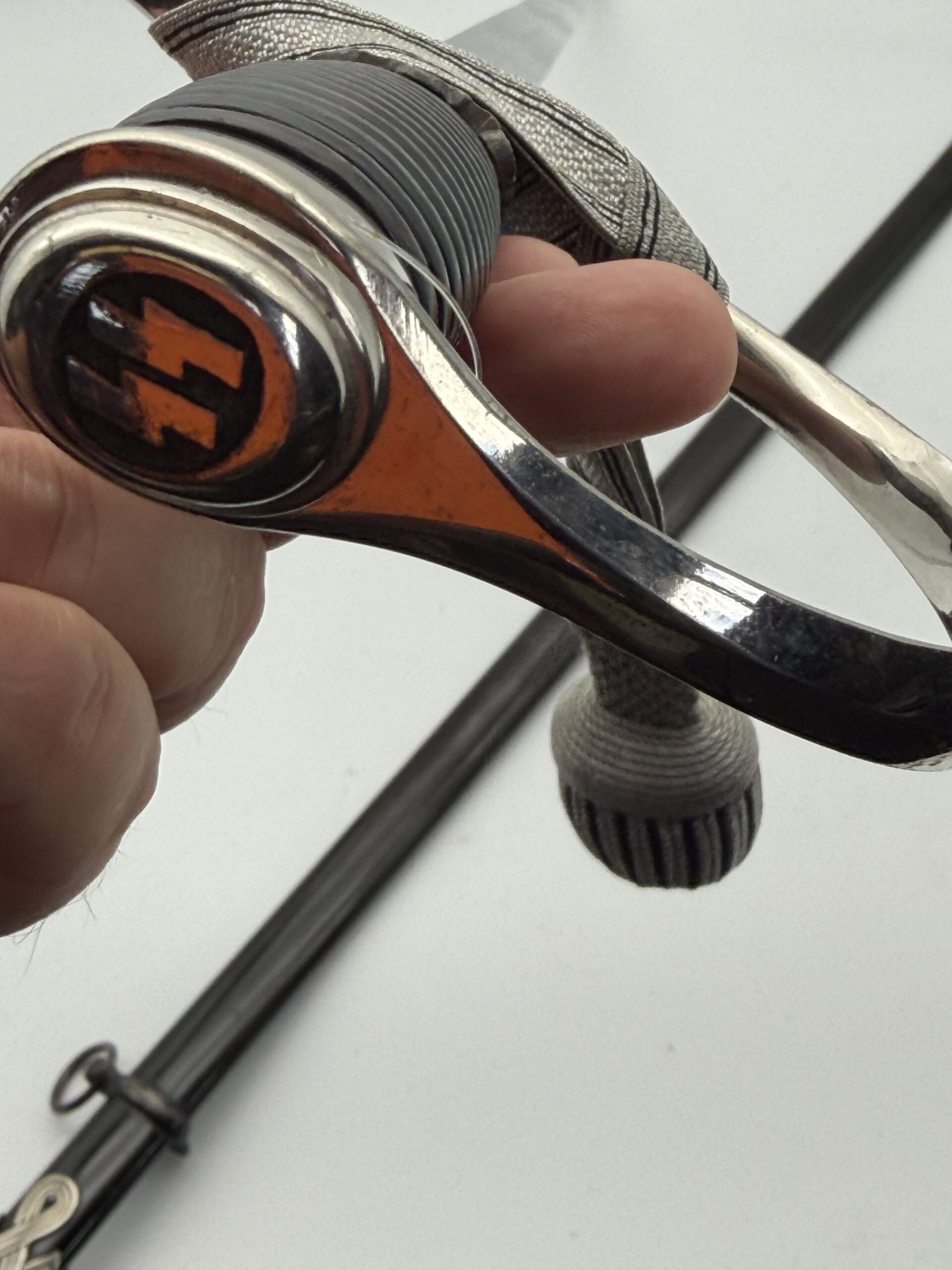
The bright blade retains the Peter Daniel Krebs, Solingen maker trademark. Moreover, the hilt displays the defining SS-Unterführer configuration: a plain black grooved grip without officer wire winding and SS runes positioned within the pommel cap.
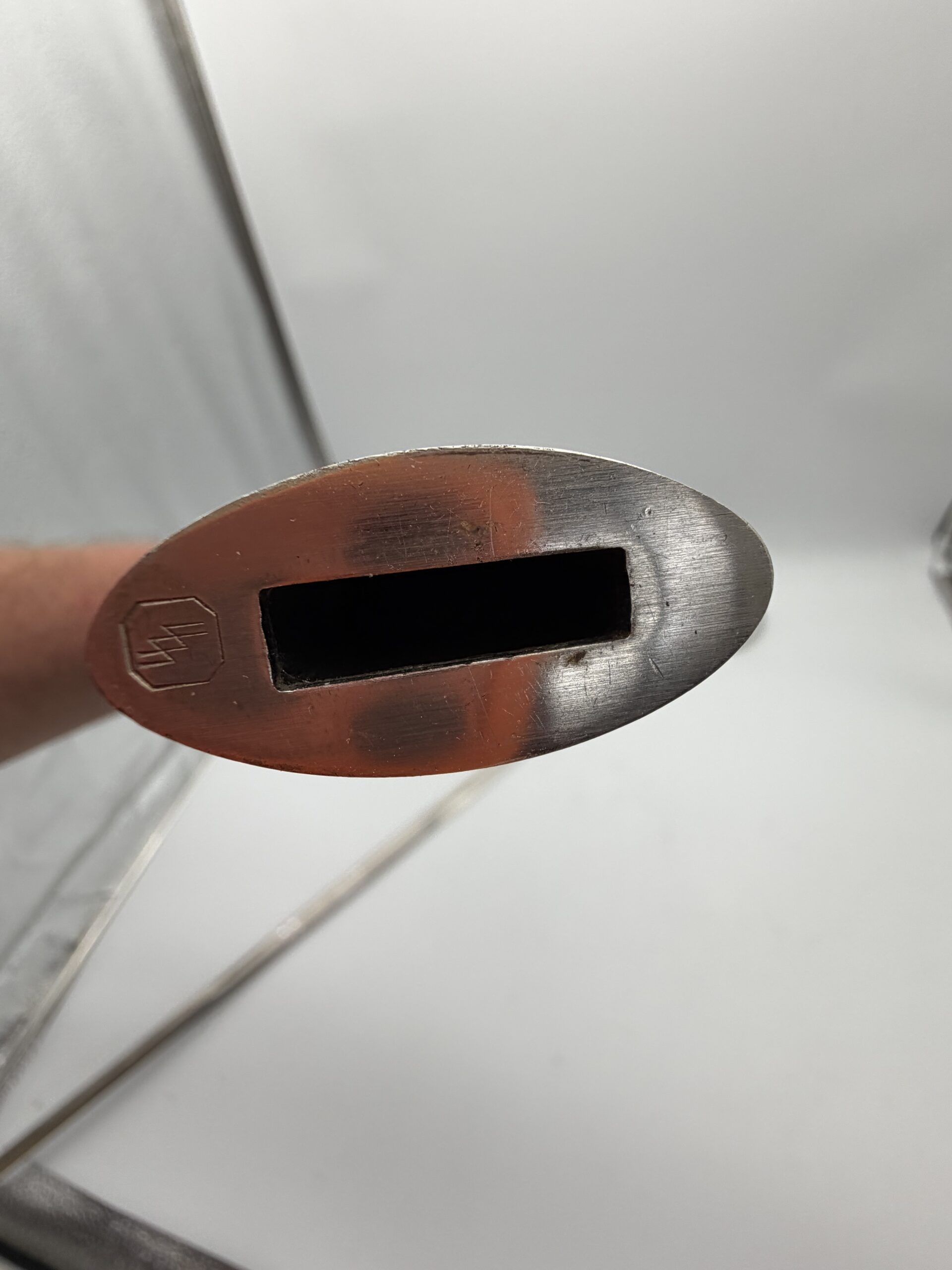
Most importantly, the scabbard throat retains the distinctive silver Germanic interlace fitting together with the SS Kulturzeichen / acceptance mark in an octagonal cartouche. The original silver-aluminium and black SS portepee remains correctly tied to the hilt.
This is an exceptionally well-preserved reference example of the SS-Unterführerdegen and represents a substantially higher grade than the majority encountered on the collector market.
€ 4.995
1 in stock
This outstanding SS Unterführerdegen Peter Daniel Krebs example represents the standard straight sword introduced for senior SS non-commissioned ranks during the mid-1930s.
Its design deliberately paralleled the SS officer’s Führerdegen. However, several construction details clearly distinguished the Unterführer version.
The present sword retains all of those defining characteristics.
A black grooved grip forms the centre of the hilt. In contrast to the officer’s sword, there is no silver-wire grip wrapping.
Instead, the characteristic SS runes appear within the pommel cap.
That feature is particularly important because it confirms the correct Unterführerdegen configuration rather than the officer’s Führerdegen pattern.
The blade carries the unmistakable maker mark of:
Solingen
Peter Daniel Krebs was one of the principal manufacturers associated with SS swords.
The firm’s blades appear on both Führerdegen and Unterführerdegen production. Consequently, Krebs remains one of the most desirable names associated with this category of SS edged weapon.
The present blade retains an exceptionally bright finish.
Its narrow fuller remains sharply defined, while the surface displays very little disruption from corrosion or later cleaning.
For an original SS sword approaching ninety years of age, the preservation is exceptional.
This sword should be catalogued specifically as an:
rather than an SS-Führerdegen.
The distinction is important.
The Unterführer sword was intended for senior non-commissioned SS personnel. Contemporary terminology covered the Portepee-Unterführer ranks.
Several details identify this example immediately.
The standard SS officer’s Führerdegen differed by using a wire-wound grip and a separate SS rune medallion set into the grip itself.
Published research into SS swords confirms this distinction: NCO swords used SS runes on the pommel cap, while officer swords employed a wire-wound grip with the SS rune emblem positioned in the grip.
One of the strongest features appears at the pommel.
A circular black field contains the stylised SS Sig runes.
The runes remain clearly visible and display natural age and toning.
Their location is correct for an SS-Unterführerdegen.
This point matters considerably during authentication because the officer and Unterführer swords should not be confused.
The pommel construction also displays the smooth contours and restrained styling associated with this purpose-designed SS sword.
An especially valuable comparison survives in the Musée de la Libération de Paris – Musée du Général Leclerc – Musée Jean Moulin.
Its collection contains an original SS-Unterführerdegen with portepee, brought back as a wartime trophy by Sergeant Pierre Courtaut of the French 2e Division Blindée.
The museum records the sword with a black grip, black lacquered scabbard, SS markings and original portepee. It also specifically identifies the object as an SS-Unterführerdegen.
Musée de la Libération de Paris – SS-Unterführerdegen with Portepee
This museum-held example provides an excellent institutional comparison for the present sword.
The scabbard throat displays another particularly important feature.
On the underside appears an SS runic acceptance or Kulturzeichen within an octagonal outline.
This mark is highly relevant to period SS sword manufacture.
Acceptance marks occur on recognised SS swords and fittings because production operated under controlled SS procurement.
The present stamp remains cleanly impressed and sits naturally within the surrounding metal surface.
Its wear also agrees with the age of the rest of the sword.
The upper scabbard fitting displays the characteristic interwoven Germanic decorative motif associated with SS swords.
Silver-coloured strips form an intricate knot-like arrangement against the black scabbard.
The design provides one of the most immediately recognisable visual characteristics of the SS sword family.
Importantly, the fitting remains extremely crisp.
Edges show little deformation, while the silvered surface retains excellent definition.
The screws and mounting points also appear untouched.
The original steel scabbard is a major strength of this example.
Its deep black lacquer remains exceptionally well preserved.
Very little significant loss appears across the body.
Furthermore, the scabbard remains straight and retains the correct suspension ring and throat fittings.
Many surviving SS swords have badly scratched, dented or repainted scabbards.
This example is dramatically stronger.
For catalogue purposes, the condition can reasonably be described as:
No restoration is recommended.
The original lacquer should remain exactly as preserved.
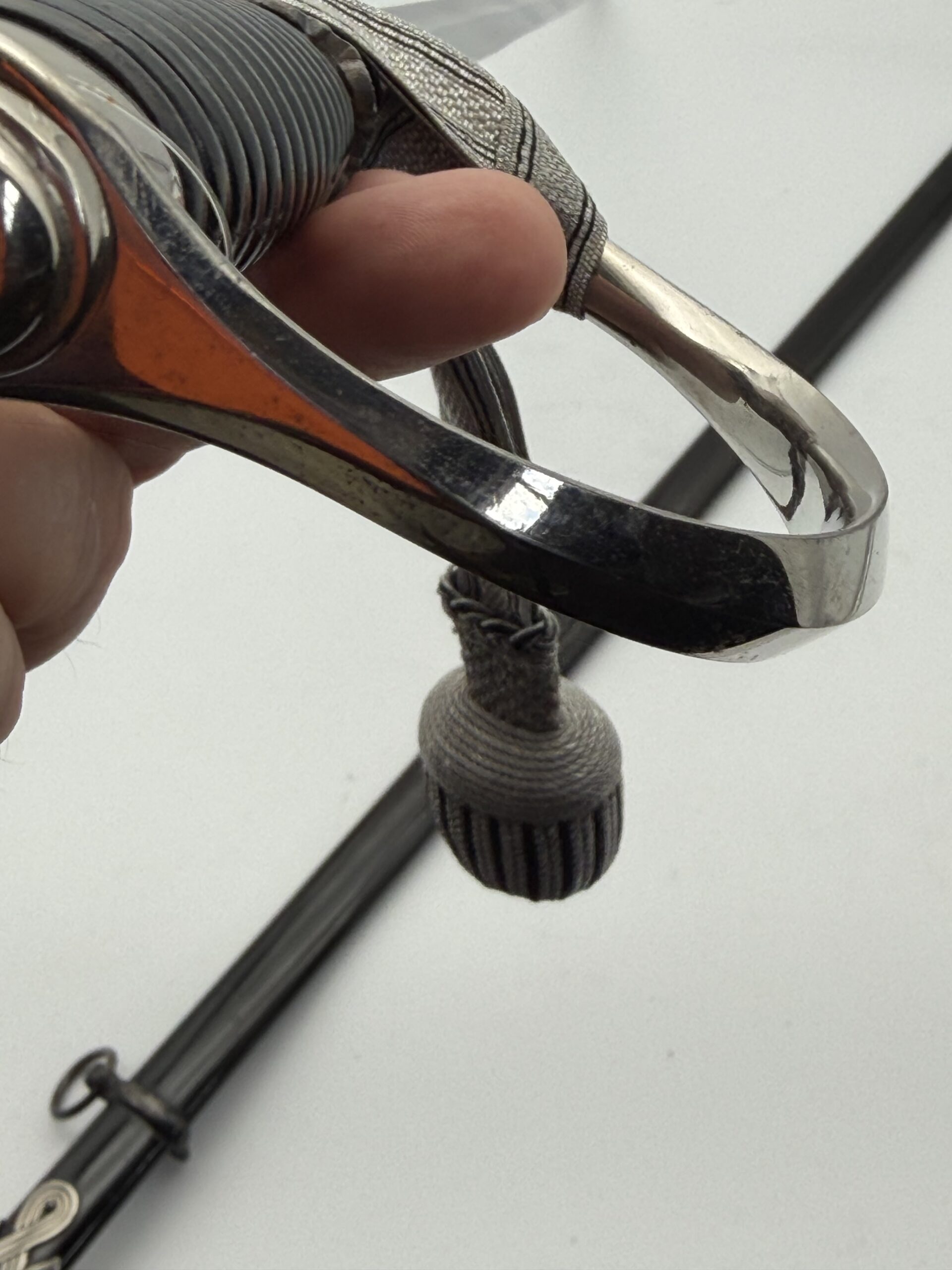
The sword retains its silver-and-black SS portepee.
Its construction uses aluminium thread with characteristic black woven accents.
The strap remains tied around the guard in the traditional manner.
Below it hangs the large enclosed tassel with alternating silver and black vertical elements.
The textile has aged naturally without losing its overall shape.
A correct original portepee adds substantially to both completeness and collector value.
Helmut Weitze documents SS-Unterführer portepees as aluminium-thread constructions with characteristic black woven stripes.
Many surviving SS-Unterführerdegen have lost their portepee.
Others appear today with incorrect Wehrmacht or reproduction knots.
Consequently, a coherent original sword-and-portepee combination deserves a clear premium.
The present knot displays:
Its preservation also corresponds closely with the exceptional condition of the sword.
Collectors frequently confuse the two patterns.
However, the distinction is straightforward.
| Feature | SS Unterführerdegen | SS Führerdegen |
|---|---|---|
| Intended wearer | Senior NCO / Unterführer | Officer / Führer |
| Grip | Plain black grooved | Black with silver wire |
| SS rune position | Pommel cap | Inset into grip |
| Hilt | Silver-coloured | Silver-coloured |
| Blade | Straight fullered | Straight fullered |
| Scabbard | Black lacquered | Black lacquered |
| Portepee | SS Unterführer type | SS Führer type |
The present example corresponds with the Unterführer pattern.
That identification is reinforced by the pommel runes and absence of officer grip wire.
Before standardised SS swords appeared, officers and NCOs could wear privately purchased military-style sabres.
During the mid-1930s, the SS introduced purpose-designed straight swords to establish a uniform appearance.
The new sword family included versions for officers, officer candidates and non-commissioned personnel.
The SS-Unterführerdegen formed an important part of that system.
Published research describes its black grooved grip, pommel runes and decorative black scabbard as characteristic features.
Peter Daniel Krebs became one of the recognised Solingen suppliers of SS swords.
A photographic archive specifically records an SS NCO sword with portepee by Peter Daniel Krebs.
Its description notes the fullered blade, Krebs maker mark, SS runes on the pommel, black grooved grip and black-painted steel scabbard.
Those characteristics correspond exceptionally closely with the present sword.
This represents one of the strongest published construction comparisons for the example offered here.
The blade is exceptionally clean.
Its polished surface remains bright across both sides.
Likewise, the fuller retains strong definition.
Only very minor storage and runner marks appear.
There is no serious pitting.
Furthermore, the cutting edges and point remain well formed.
The Peter Daniel Krebs trademark remains crisp and fully legible.
This level of blade preservation is considerably above average.
The nickel-plated hilt remains equally impressive.
Its D-shaped guard retains a smooth, highly reflective surface.
Likewise, the pommel fittings show very little plating loss.
The black grip remains structurally excellent.
Minor age traces appear within individual grooves, but these marks provide natural evidence of age rather than detracting from the presentation.
The complete hilt has not been aggressively polished.
As a result, the original surfaces remain highly attractive.
The supplied photographs show an exceptionally coherent original SS-Unterführerdegen.
Important positive features include:
Taken together, these characteristics provide a very strong period-manufacture profile.
The sword is also directly comparable with museum-held and published original SS-Unterführerdegen examples.
Overall preservation can accurately be described as:
The blade remains exceptionally bright.
Meanwhile, the nickel-plated fittings retain impressive original finish.
The grip remains structurally sound.
Likewise, the black scabbard retains outstanding lacquer.
The SS acceptance mark remains clearly visible.
Finally, the period portepee completes the ensemble.
This is considerably stronger than the majority of SS-Unterführerdegen encountered on the market.
No restoration or cleaning is recommended.
Ordinary SS-Unterführerdegen in good collector condition can trade around the €2,000 level.
However, those figures often concern swords with substantially more wear, questionable portepees or incomplete accessories. Specialist collector discussion in 2024 placed a good basic example around this level.
Auction records also show complete Krebs SS sword combinations reaching higher levels. An SS-Unterführerdegen by Krebs with portepee and hanger has previously sold around €2,700, while separate authentic SS sword portepees can themselves represent a significant collector value.
The present example deserves a clear premium because of its museum-standard preservation, excellent blade, exceptional scabbard and coherent original portepee.
A reasonable specialist retail range would be approximately:
Item: SS ceremonial sword
Correct designation: SS-Unterführerdegen
Organisation: Schutzstaffel / SS
Intended rank class: Senior NCO / Portepee-Unterführer
Manufacturer: Peter Daniel Krebs
Location: Solingen
Blade: Bright straight fullered steel
Hilt: Nickel-plated / silver-coloured
Grip: Black grooved composition or finished wood
Grip wire: None – correct Unterführer configuration
SS insignia: Runic emblem within pommel cap
Acceptance mark: SS runes in octagonal cartouche
Scabbard: Original black lacquered steel
Scabbard decoration: Germanic interlace throat fitting
Portepee: Original SS Unterführer silver-and-black type
Condition: Excellent / Museum Standard
Rarity: Very rare in this condition
Short ID: SS-UFD-KREBS-01
Explore related listings: Military Swords; Original SS-Verfügungstruppe Deutschland BeVo Flatwoven Cuff Title; Original SS-Hauptamt Officer Cuff Title with Original RZM Label; Nordmenn Militaria Collection.
The strongest institutional comparison is the original sword preserved by the Musée de la Libération de Paris.
Musée de la Libération de Paris – SS-Unterführerdegen with Portepee
The museum identifies its example specifically as an SS-Unterführerdegen mit Portepee.
Helmut Weitze – SS Unterführerdegen Portepee Reference
Weitze confirms the aluminium-thread and black-stripe construction associated with the SS-Unterführer knot.
The German National Library catalogue records specialist reference material containing dedicated sections for the SS-Führerdegen, SS-Unterführerdegen and SS sword accoutrements.
No.
This example is correctly identified as an SS-Unterführerdegen.
The plain grooved grip and SS runes in the pommel distinguish it from the officer’s Führerdegen.
Peter Daniel Krebs of Solingen manufactured the blade.
The maker’s trademark remains clearly visible.
The pattern was intended for senior SS non-commissioned personnel or Portepee-Unterführer.
That is a defining characteristic of the Unterführer version.
Officer swords instead used the SS rune medallion within the grip.
No.
The absence of officer-style wire winding is correct for this configuration.
The silver-coloured upper fitting uses the distinctive Germanic interlace or knot motif associated with SS swords.
Yes.
The octagonal SS runic acceptance mark provides another significant period-manufacture feature.
Its silver/aluminium construction and black woven stripes correspond with recognised SS Unterführer sword knots.
Yes.
The Musée de la Libération de Paris preserves an original SS-Unterführerdegen with portepee as a documented wartime trophy.
The blade, hilt, scabbard and fittings remain exceptionally well preserved.
That valuation reflects the museum-standard condition, desirable Krebs manufacture, complete scabbard, SS acceptance marks and surviving portepee.