
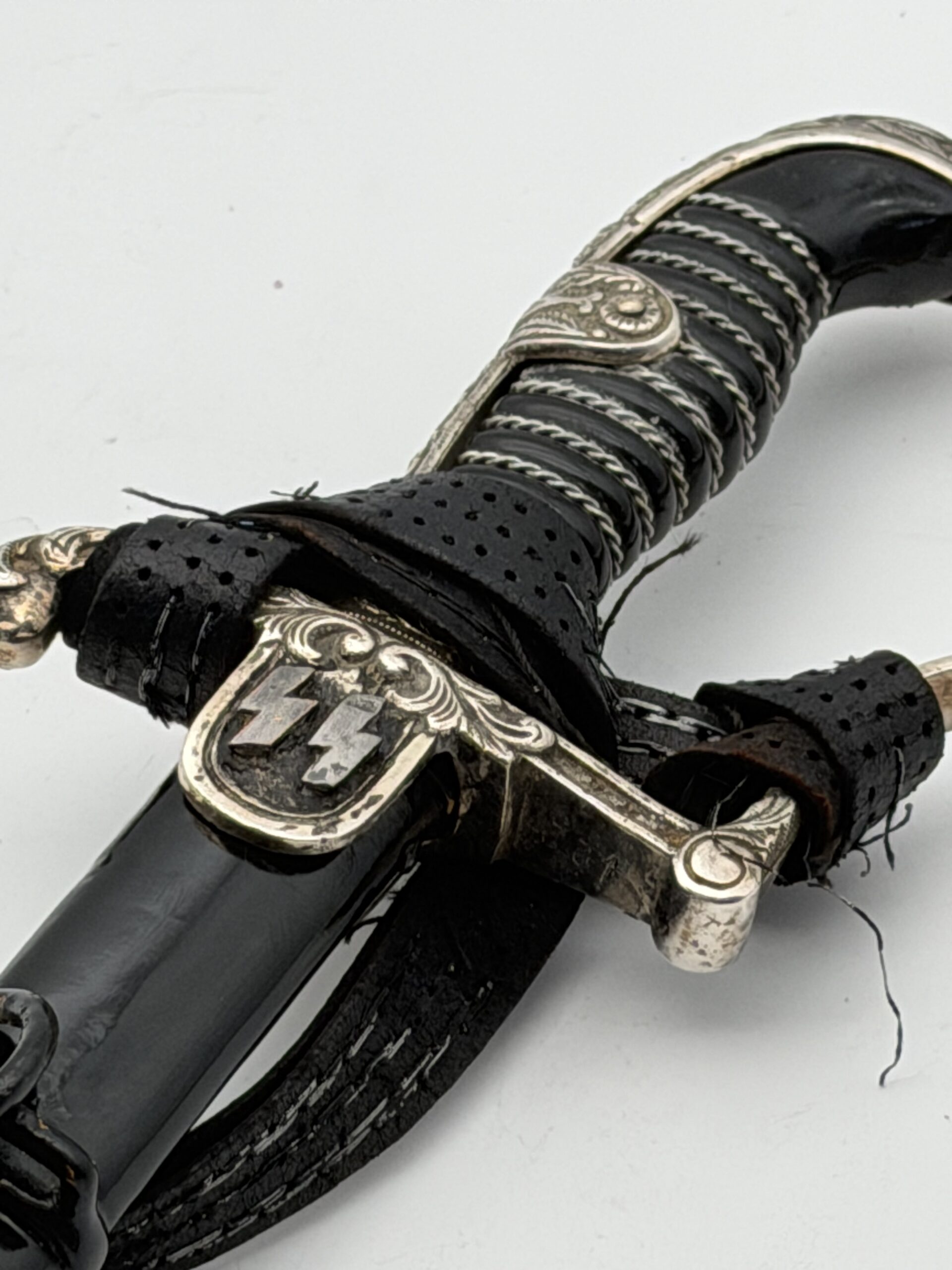
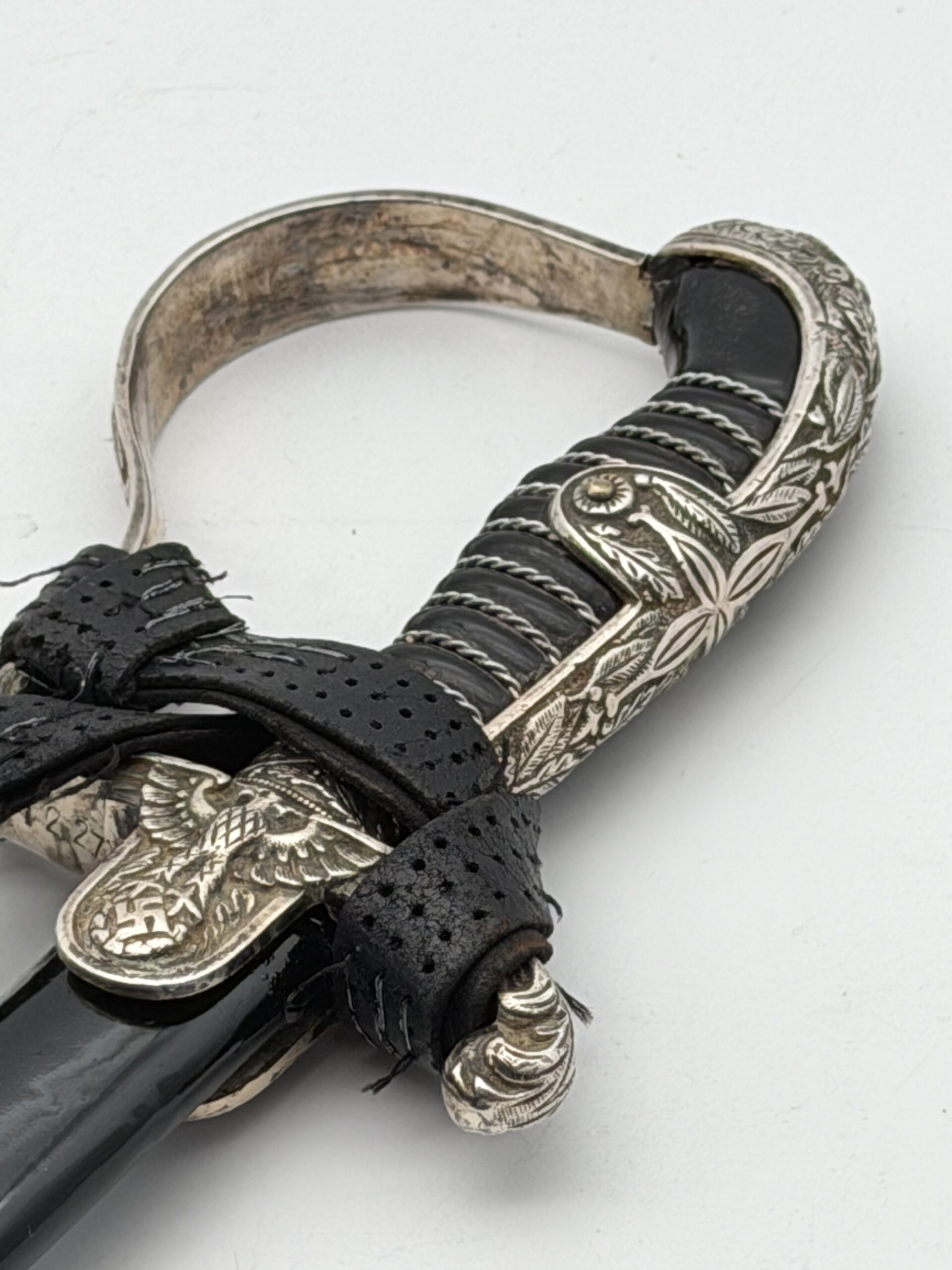
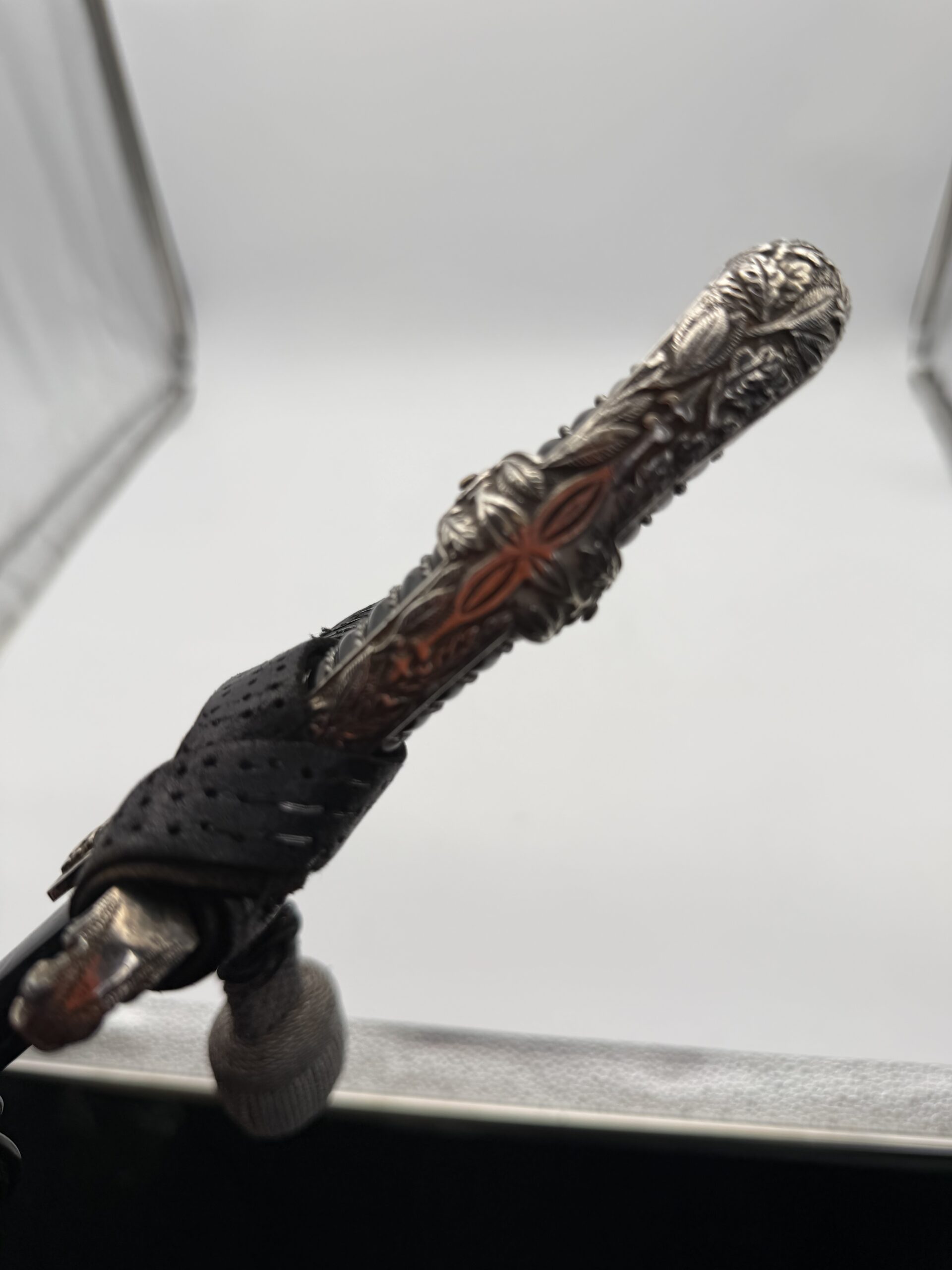
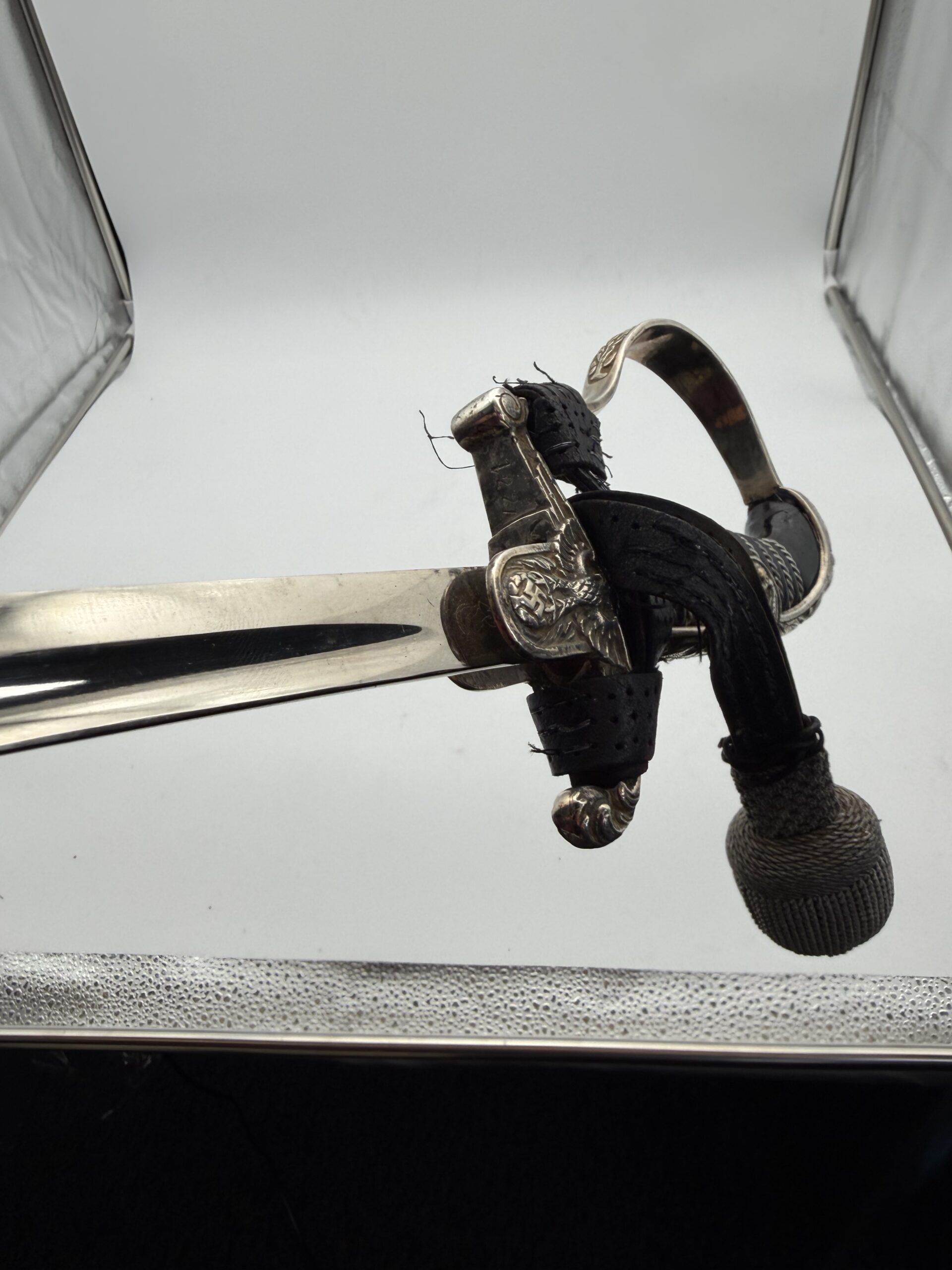
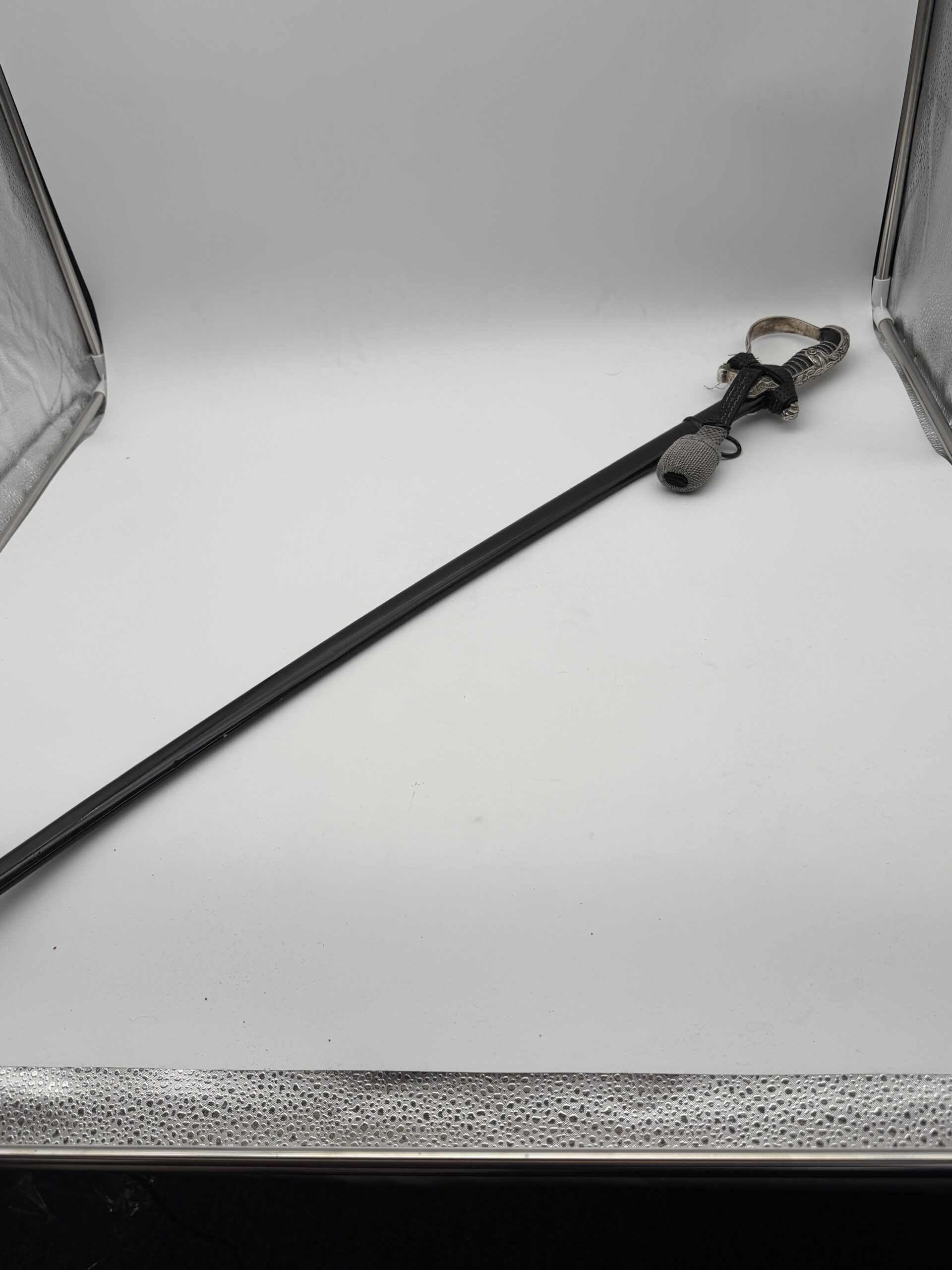
An exceptionally scarce Early SS Officer Sabre dating from the formative pre-Führerdegen period of approximately 1933–1936.
This privately purchased Army-pattern sabre was finished in silver-coloured metal for SS wear and incorporates a distinctive SS runic langet opposite the national eagle and swastika. The elaborate hilt retains a black ribbed grip with multiple silver-wire windings, finely decorated backstrap and knuckle bow, while the long bright fullered blade remains particularly attractive.
Complete with its original black-painted steel scabbard and surviving period sword-knot and leather strap assembly.
Contemporary SS uniform references confirm that before the introduction of the standardised SS Führerdegen, SS officers used privately purchased Army-pattern sabres, frequently with silver rather than gilt fittings. Certain surviving examples were additionally customised with SS runes.
€ 6.500
1 in stock
This Early SS Officer Sabre belongs to the transitional period before the introduction of the familiar straight-bladed SS Führerdegen.
During the first years of the Third Reich, the rapidly expanding SS had not yet standardised every element of ceremonial equipment.
Consequently, SS officers and selected NCOs could use privately purchased German Army-style sabres for parade, formal duty and ceremonial wear.
The principal visual distinction was often the finish.
Where Army officer sabres normally carried gilt or gold-coloured fittings, examples intended for SS use frequently employed nickel, silvered or white-metal fittings instead.
Published SS uniform research specifically confirms this practice during the 1933–1936 period.
This sword should not be catalogued as the later Reichsführer-SS Führerdegen.
The standardised SS officer sword introduced during the mid-1930s had a fundamentally different construction.
That later pattern featured a straight blade, restrained D-shaped guard, black grip and inset SS rune device.
By comparison, the present Early SS Officer Sabre retains the elaborate architecture of a traditional privately purchased officer’s sabre.
Its construction includes:
The design therefore belongs to the pre-standardisation SS sabre tradition.
The strongest documentary support comes from published research into SS uniforms and sidearms.
Andrew Mollo’s study of SS uniforming states that before the introduction of the SS sword in 1935, officers wore Army-pattern sabres finished in silver rather than Army gilt.
That source also records surviving examples bearing SS runes on the reverse langet.
A separate historical study likewise confirms that between approximately 1933 and 1936, SS officers and NCOs performing ceremonial duties could wear a variety of privately purchased Army-pattern sabres.
Again, silver or white-metal fittings are specifically noted as characteristic of SS use.
This evidence is particularly important because it establishes that such swords were not required to conform to one universal catalogue model.
Instead, several commercial sword patterns could appear in SS service.
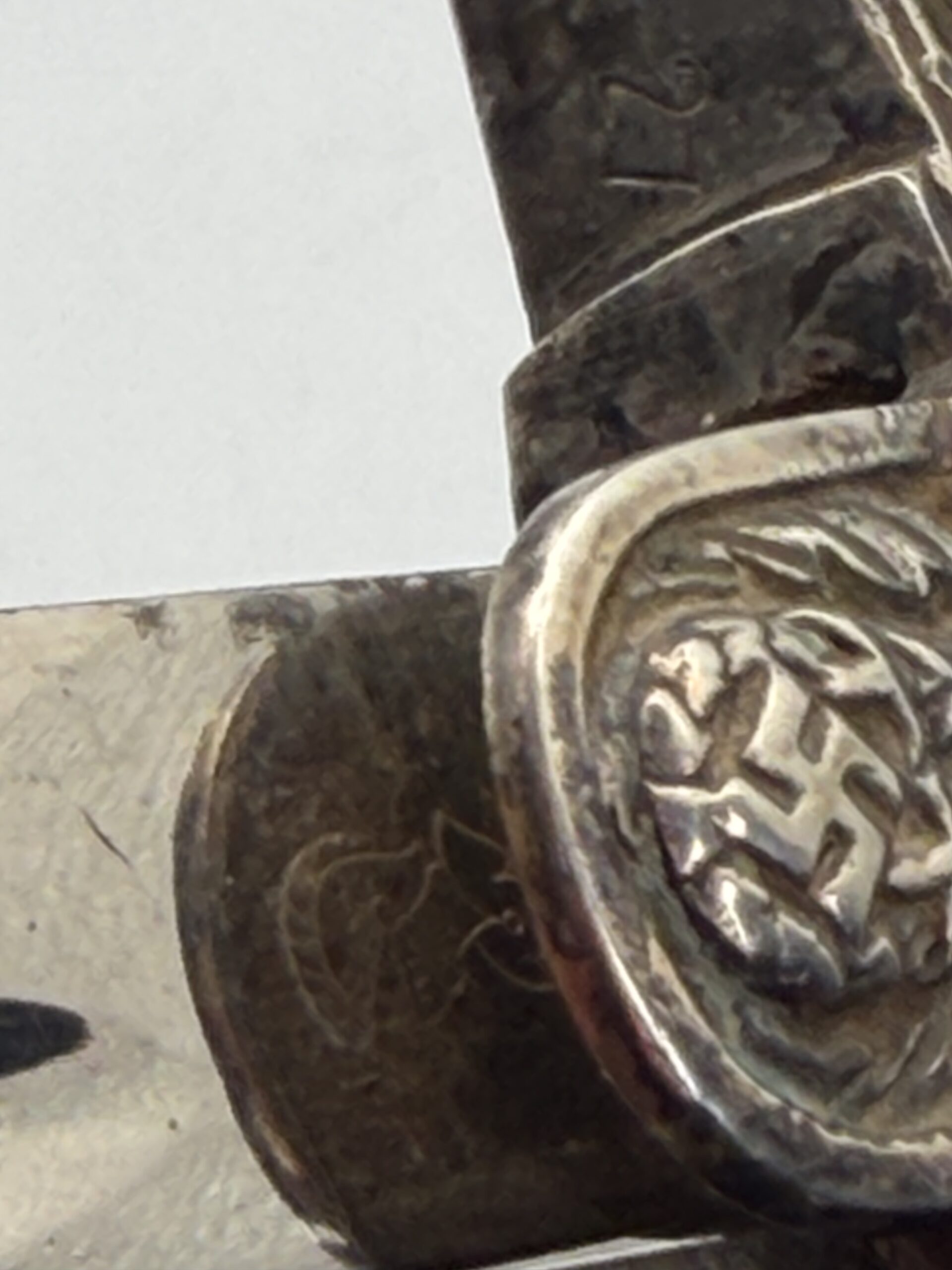
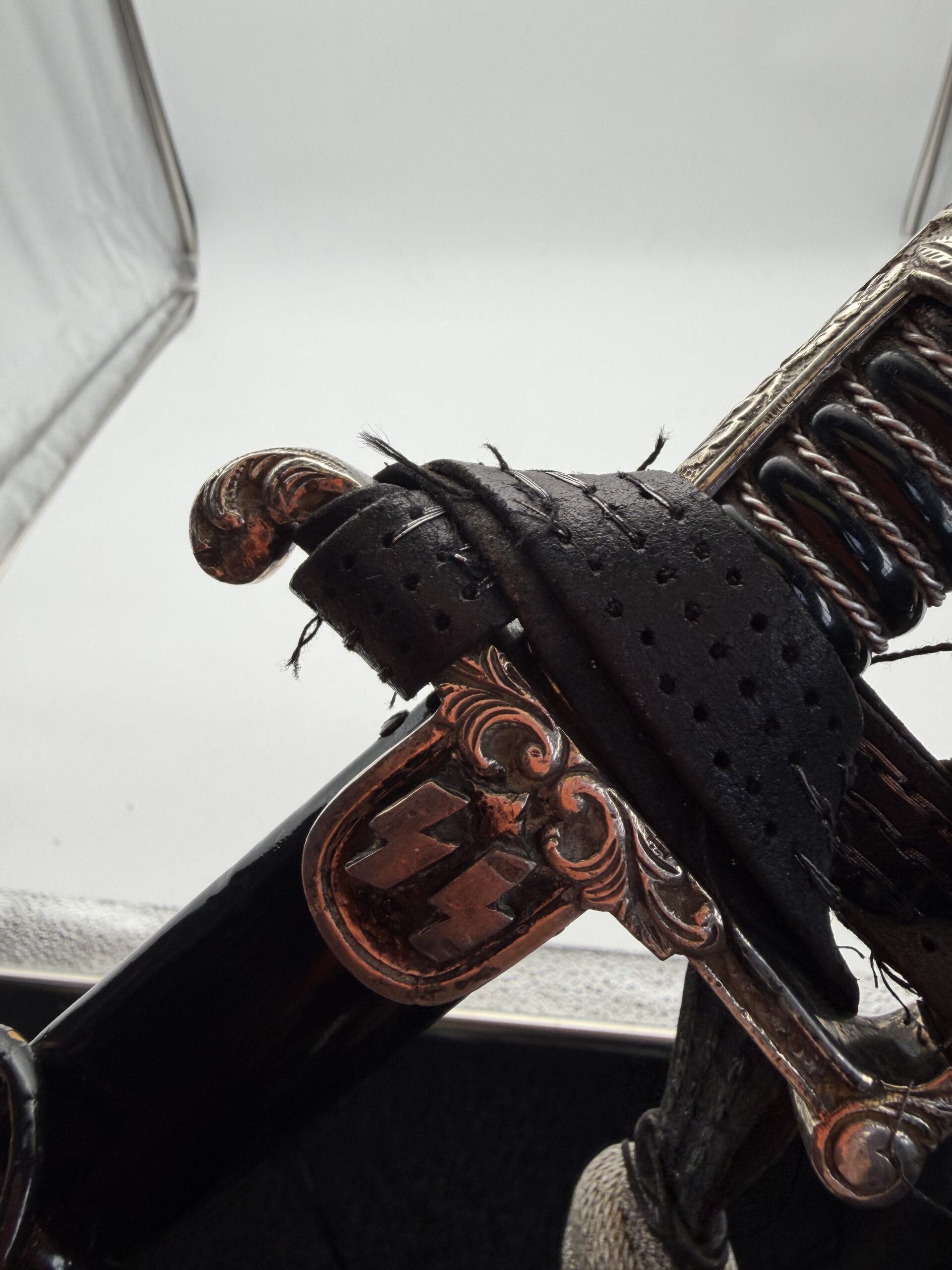
The most significant SS-specific feature appears on the langet.
A pair of raised SS Sig runes sits within a decorative shield-like panel.
Floral scrollwork surrounds the runes.
This feature immediately differentiates the sword from a conventional Army officer’s sabre.
The opposing langet carries the German national eagle and swastika.
Together, these two motifs create an unmistakably SS-oriented ceremonial configuration.
The runic device also displays wear and patination consistent with the surrounding hilt rather than appearing dramatically newer than the rest of the sword.
The opposite langet displays a detailed national eagle above the swastika.
Wing and feather definition remain clearly visible.
Meanwhile, the surrounding silvered metal has developed attractive natural toning.
The relief decoration sits naturally within the broader hilt design rather than appearing as a crude later attachment.
This combination of national eagle on one side and SS runes on the other makes the sword considerably more important than a generic silver-plated officer’s sabre.
The complete hilt uses a silver-coloured finish rather than Army gilt.
That characteristic is central to the identification.
Original references specifically describe silver-finished Army-pattern swords as being worn by SS personnel before standardisation of the dedicated SS Führerdegen.
The present hilt displays a subdued silver-grey appearance.
Protected recesses contain darker oxidation.
Conversely, projecting surfaces retain brighter highlights caused by handling and wear.
This tonal variation creates a particularly convincing period appearance.
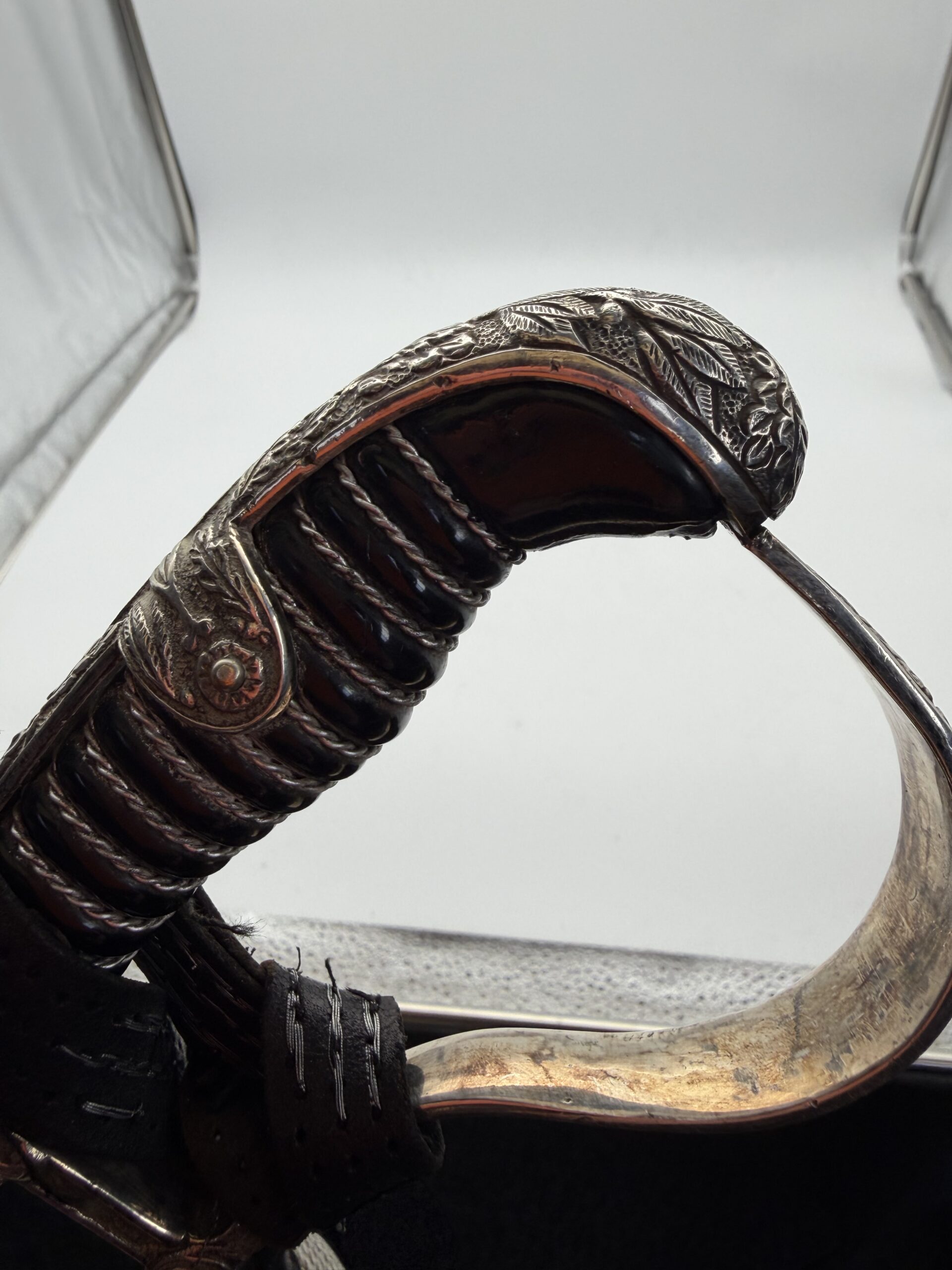
The ornate backstrap extends along the rear of the grip.
Raised floral and oak-leaf style decoration covers much of the surface.
A separate decorative panel appears near the centre.
Additional floral relief surrounds the upper pommel area.
The workmanship is considerably more elaborate than that encountered on the later standard SS Führerdegen.
Such decoration reflects the commercial officer-sword tradition from which these early SS sabres developed.
The grip uses a glossy black composition-covered core.
Deep horizontal ribs run around its surface.
Multiple silver-coloured twisted wire strands sit within the grooves.
The wire remains substantially complete.
Moreover, the black grip shows age and wear compatible with the hilt.
This combination of black and silver fitted the visual language of early SS uniform equipment particularly well.
A broad knuckle bow connects the guard with the pommel.
Its outer surface carries detailed floral decoration.
Silver plating remains visible over much of the fitting.
The interior shows natural age toning and signs of genuine handling.
Notably, this ornate curved architecture differs completely from the restrained D-guard of the later SS Führerdegen.
That distinction provides another strong indication of the sword’s early privately purchased origin.
The long blade remains bright and highly attractive.
A substantial fuller extends along much of its length.
Only moderate runner marks and age-related surface traces can be seen in the supplied photographs.
The blade has not suffered the extensive corrosion frequently encountered on long German ceremonial swords.
No visible presentation inscription appears in the photographs supplied.
Likewise, no clear commercial blade maker trademark can presently be confirmed.
Therefore, the catalogue should not assign a manufacturer unless a maker mark is subsequently photographed.
A faint assembly or inspection marking can be seen around the hilt area.
However, that is not sufficient to identify the sword manufacturer.
German firms such as Eickhorn, Alcoso, WKC, Hörster and others offered extensive officer-sabre ranges.
Several could supply special finishes or customised insignia.
Accordingly, the correct catalogue entry is:
This is preferable to forcing the sword into a specific maker catalogue without documentary evidence.
The sword retains its long black-painted steel scabbard.
Its finish remains extremely presentable.
The body follows the blade curvature correctly.
Additionally, the suspension fittings remain intact.
Small handling marks and finish wear provide natural evidence of age.
The black scabbard also agrees with documented SS use of Army-pattern sabres with white-metal fittings.
A substantial sword-knot or wrist-strap assembly remains tied around the hilt.
The accompanying material shows significant age.
Black perforated leather elements display:
A darkened metallic-textile tassel also survives.
Because the exact knot configuration is partially obscured by the leather and hilt, it should presently be described conservatively as a:
rather than making an unsupported precise rank attribution.
Importantly, it should remain attached exactly as found.
The early SS was expanding extremely rapidly between 1933 and 1935.
Uniform regulations therefore developed alongside the organisation rather than appearing fully standardised from the outset.
The SS-Verfügungstruppe itself emerged from earlier armed SS formations during 1934 and subsequently became one of the foundations of the Waffen-SS. The Bavarian historical portal places the formation of the SS-Verfügungstruppe within this same 1934 transition.
During this early period, officers could therefore appear with sabres derived directly from Army commercial models.
Only later did the SS establish its distinctive standard sword.
Interestingly, introduction of the dedicated SS sword did not make every older sabre disappear immediately.
A surviving Waffen-SS uniform reference notes that at the beginning of the war, officers could still be seen wearing Army-pattern sabres with white-metal fittings, even though the design had become obsolete.
That evidence is valuable.
It demonstrates that early silver SS sabres could remain in service beyond their original pre-1936 acquisition period.
Therefore, the sword’s practical period of wear may have extended into the early war years.
The SS-Verfügungstruppe provides the strongest organisational context for ceremonial military-style sabres of this period.
The SS-VT began to develop formally during 1934 and became increasingly military in organisation.
Its formations eventually included the Standarten:
Deutschland
Germania
and later
Der Führer.
By 1940, these armed SS formations formed a principal nucleus of the Waffen-SS.
The sword itself does not identify a particular regiment.
Therefore, it would be incorrect to assign it specifically to Deutschland, Germania or Der Führer without provenance.
A particularly important surviving comparison is the presentation sabre of Fritz Klingenberg.
Helmut Weitze documents Klingenberg’s silver-finished lion-head sabre as an SS-Verfügungstruppe officer weapon presented on his promotion to SS-Untersturmführer on 20 April 1935.
That sword was manufactured by Alcoso as its SS-VT Model 113 and uses a nickel-silver hilt rather than the familiar gilt Army finish.
The Klingenberg sword is not the same commercial model as the present example.
However, it provides powerful independent evidence that special silver-finished commercial sabres were being used by SS-VT officers in precisely this period.
Helmut Weitze – Fritz Klingenberg SS-Verfügungstruppe Sabre
Collectors should not confuse this sword with the later SS Führerdegen.
The differences are substantial.
The early sabre belongs to the traditional German commercial sword family.
By contrast, the dedicated SS Führerdegen introduced a new SS-specific design.
Its characteristic elements included a straight narrow blade, D-shaped knuckle bow, black grip and dedicated SS rune device.
The standard SS officer sword subsequently became an awarded prestige weapon associated with SS officer schools and senior command appointments.
The present sword predates or stands outside that standardised system.
That fact makes it particularly interesting.
The supplied photographs provide a coherent set of characteristics consistent with a genuine early SS-associated sabre.
Positive features include:
the correct silver-coloured SS-era finish, elaborate commercial officer-sabre construction, black wire-bound grip, national eagle langet, opposing SS runes, period black steel scabbard and coherent age throughout.
Most importantly, published SS uniform references directly confirm that Army-pattern sabres with silver or white-metal fittings were authorised and worn by SS officers during the pre-standardisation period.
The present sword therefore fits an historically documented category.
However, one important authentication point remains.
The SS runic langet should be examined carefully under magnification to establish whether its patina, attachment method and manufacturing characteristics are completely contemporary with the rest of the hilt.
From the photographs, the ageing appears encouraging.
Overall condition is very good original display condition.
The long blade remains bright.
Silvered hilt fittings retain strong detail.
Black grip material remains intact, while the wire winding survives substantially complete.
The langet insignia remains sharply visible.
Likewise, the black scabbard retains very strong finish.
The leather strap assembly displays significantly more wear and should not be restored.
No aggressive polishing is recommended.
Existing patina strengthens the historical character of the sword.
An ordinary Third Reich Army officer sabre is comparatively easy to obtain.
A correctly configured Early SS Officer Sabre belongs to an entirely different collecting category.
The production and wear period was short.
Furthermore, many early privately purchased swords were replaced after introduction of the dedicated SS Führerdegen.
Others lost their SS-specific components after 1945.
Consequently, surviving silver sabres with period SS runic treatment remain scarce.
| Specification | Details |
|---|---|
| Item | Early SS ceremonial officer sabre |
| Preferred designation | Early SS Officer Sabre / SS-Säbel |
| Period | Circa 1933–1936, with possible continued later wear |
| Organisation | SS / possible SS-Verfügungstruppe context |
| Pattern | Privately purchased Army-style officer sabre |
| Hilt finish | Silvered / white metal |
| Front langet | National eagle and swastika |
| Reverse langet | Raised SS runes |
| Grip | Black ribbed composition |
| Grip wire | Multiple silver-coloured strands |
| Backstrap | Ornate floral decoration |
| Blade | Long bright fullered steel |
| Maker | Presently unconfirmed |
| Scabbard | Black-painted steel |
| Accessories | Period sword-knot / leather strap assembly |
| Condition | Very good |
| Rarity | Very rare |
| Short ID | SS-EARLY-SABRE-01 |
| Recommended retail | €6,995 |
Explore related listings: Military Swords; Original SS-Verfügungstruppe Deutschland BeVo Flatwoven Cuff Title; SS-1 Standarte Deutschland Collar Tabs; Nordmenn Militaria Collection.
The Fritz Klingenberg sabre provides an important named 1935 comparison for silver-finished SS-VT officer swords.
Weitze – Fritz Klingenberg SS-Verfügungstruppe Sabre
Bavarikon – Historical Overview of the SS and SS-Verfügungstruppe
Bundesarchiv – SS-Verfügungstruppe Historical Documentation
These references establish the historical context independently of modern dealer descriptions.
It is a rare early SS officer sabre based on a privately purchased German Army officer-sabre pattern.
Published SS uniform research confirms that SS personnel frequently used Army-pattern sabres finished in silver or white metal instead of regulation Army gilt during the early period.
The strongest identifying feature is the raised SS runic langet, combined with the silvered hilt and opposing national eagle.
No.
The Führerdegen is the later standardised straight SS sword.
This example belongs to the earlier privately purchased sabre tradition.
The strongest period is approximately 1933–1936.
However, period research confirms that obsolete Army-pattern white-metal sabres could still be worn by Waffen-SS officers into the early war period.
The historical configuration is entirely appropriate to the early SS-VT period.
However, without named provenance or a unit marking, a particular SS-VT regiment should not be assigned.
No.
Klingenberg’s 1935 sword is an Alcoso Model 113 lion-head sabre.
Nevertheless, it independently proves the documented use of luxury silver-finished commercial sabres by SS-VT officers during this exact period.
No conclusive maker mark is visible in the supplied photographs.
The manufacturer should therefore remain unconfirmed until the blade ricasso or concealed area beneath the langet is examined.
Its ageing appears period-consistent.
However, the precise classification of the strap and knot should remain conservative until examined separately.