
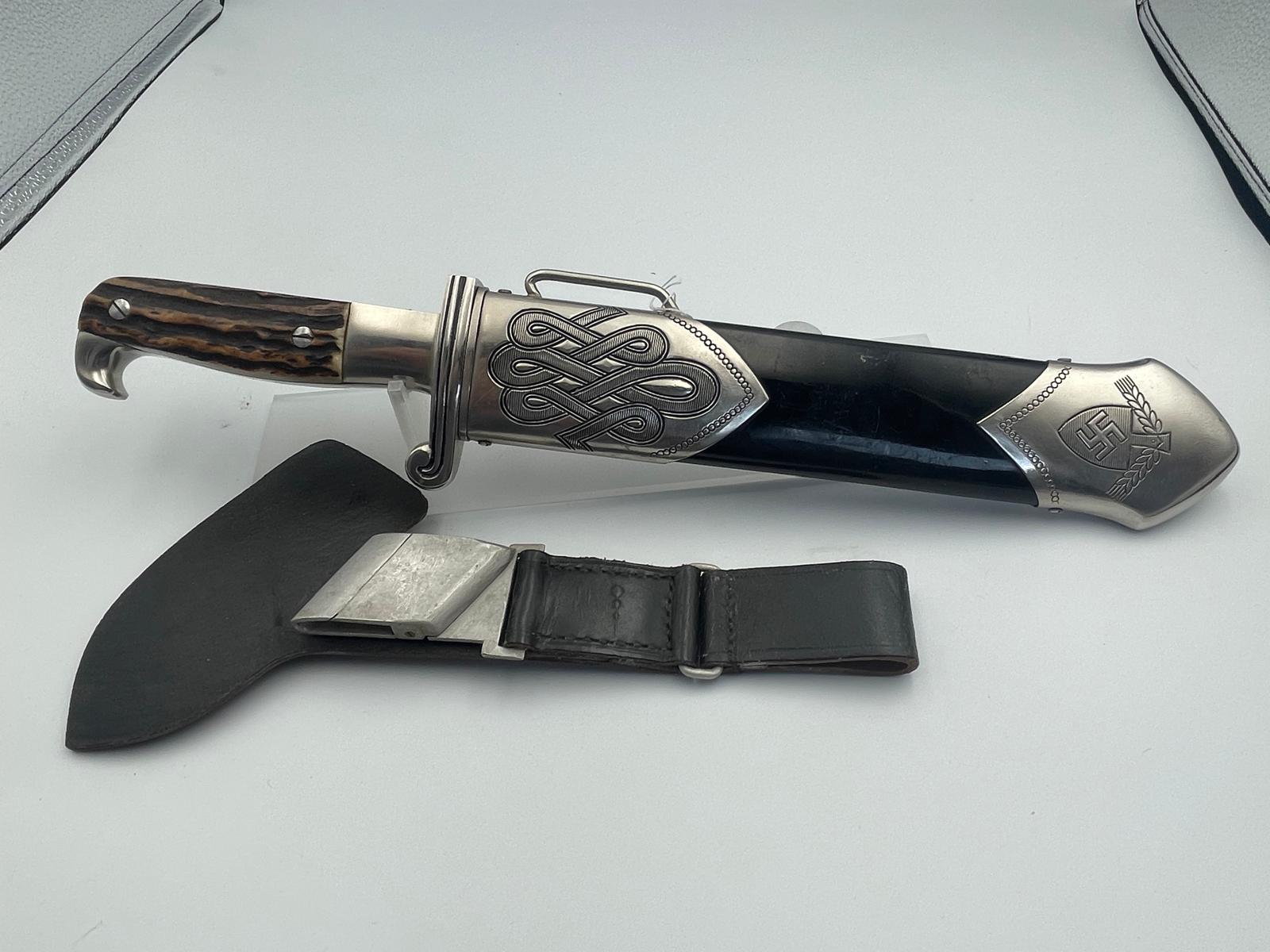
An exceptionally attractive Ed Wüsthof RAD Hewer for Mannschaften and Unterführer, manufactured in Solingen and complete with its original decorated black scabbard and period leather suspension hanger.
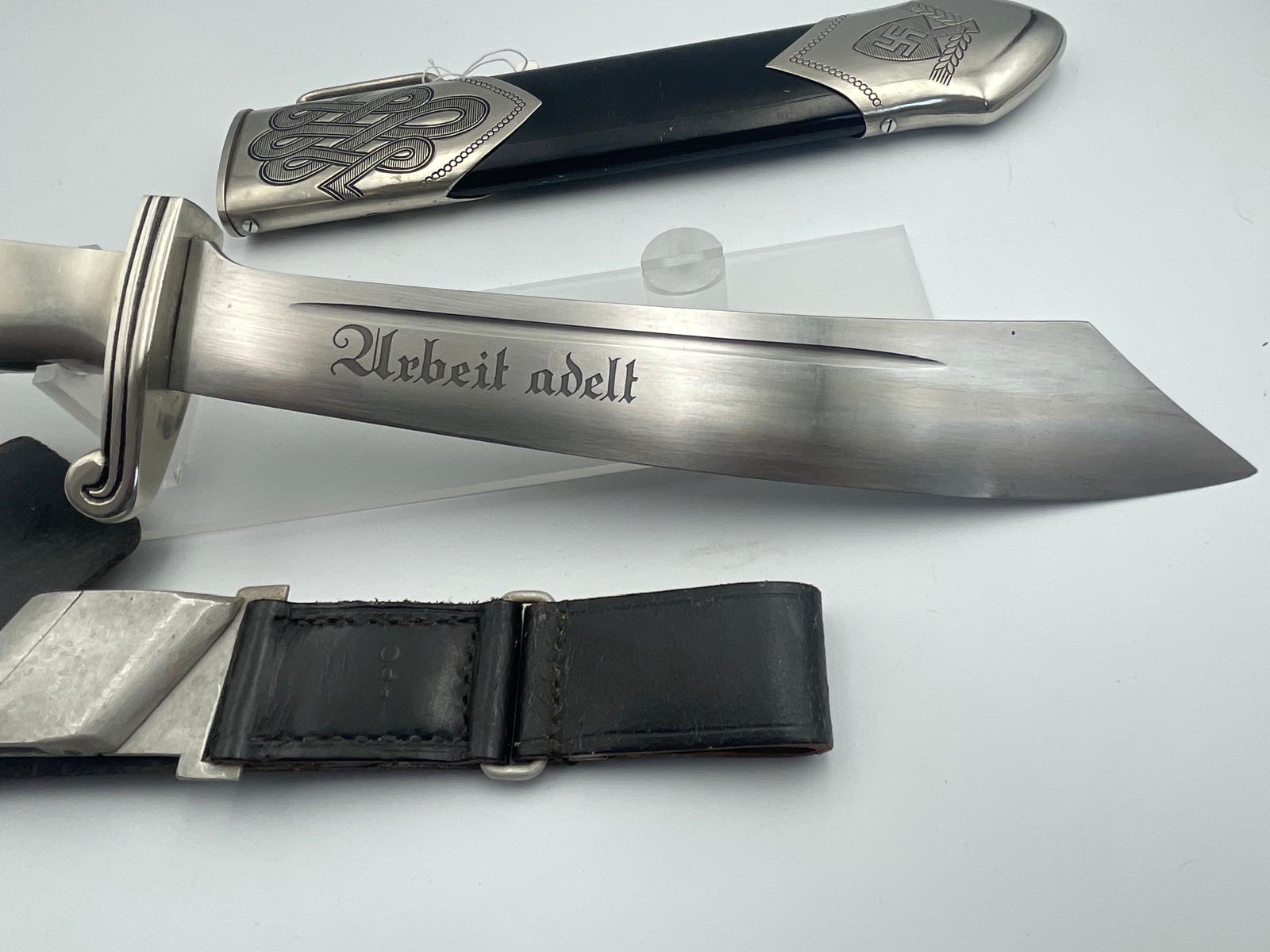
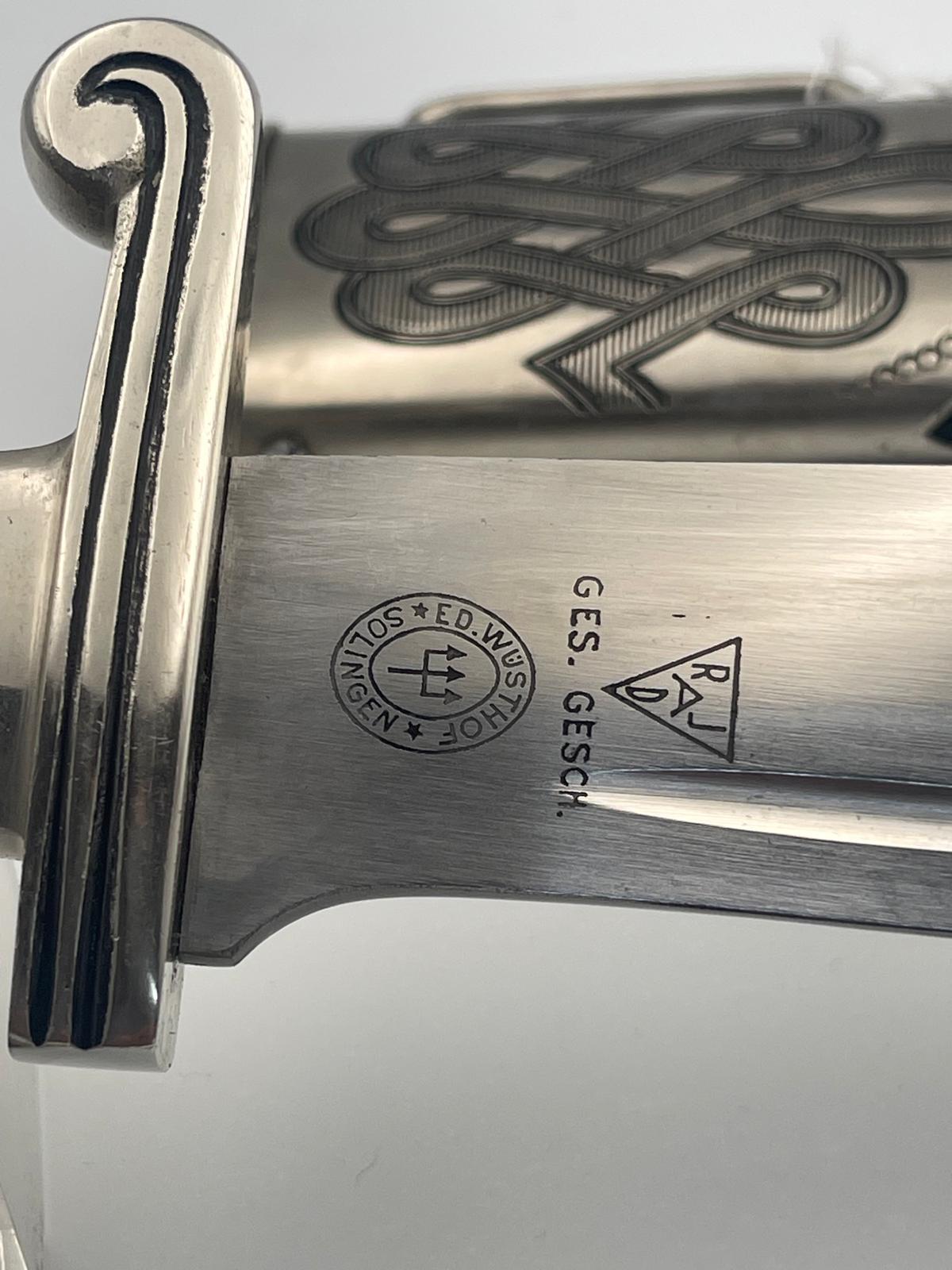
The heavy blade retains the deeply etched “Arbeit adelt” motto together with the distinctive circular Ed. Wüsthof Solingen trident trademark, triangular RADJ acceptance mark and Ges. Gesch. designation.
Rich natural stag-horn grip plates, substantial early nickel-silver fittings and an unusually clean blade make this a particularly strong example. Moreover, both elaborate scabbard mounts remain exceptionally crisp.
Most importantly, the scarce black leather hanger survives with the hewer. Complete examples are increasingly difficult to locate.
€ 2.750
1 in stock
The manufacturer represents one of the most interesting aspects of this example.
The reverse ricasso carries the circular trademark:
ED. WÜSTHOF
SOLINGEN
surrounding the famous trident emblem.
Ed. Wüsthof was a long-established Solingen blade manufacturer. Wüsthof’s own corporate history traces the company to 1814, when Johann Abraham Wüsthof established his steel and cutlery business in the Solingen area.
The Wüsthof trademark therefore came from an established Solingen manufacturer rather than a short-lived wartime contractor.
More importantly for collectors, Ed Wüsthof is a substantially less frequently encountered RAD hewer maker than Carl Eickhorn.
A specialist German dealer describes an early Wüsthof RAD Mannschaften/Unterführer hewer as carrying the same Ed Wüsthof Solingen, RADJ and Ges. Gesch. markings, while specifically noting the maker as very scarce.
The circular Wüsthof trademark remains exceptionally clear on this blade.
At the centre sits the company’s famous trident.
Wüsthof adopted the trident as its registered trademark during the late nineteenth century. Consequently, its appearance on this RAD blade provides a strong and immediately recognisable maker identification.
The mark on the present hewer displays good depth and correct positioning.
No attempt should be made to polish this area further. Preserving the original surface and sharply defined markings is far more important.
Alongside the Wüsthof trademark appears the triangular RADJ inspection or organisational mark.
Immediately beside it is:
GES. GESCH.
This abbreviation represents Gesetzlich Geschützt, indicating a legally protected design.
An independently catalogued Wüsthof M1934 hewer records precisely this combination of:
That documented configuration provides an especially useful comparison for the present example.
The imposing single-edged blade carries the RAD motto:
Literally translated, the phrase means “Work ennobles.”
Its Gothic-style lettering remains dark, deep and exceptionally legible.
A long narrow fuller runs along the blade before terminating toward the clipped Bowie-style point.
The blade surface itself remains remarkably clean.
Fine longitudinal finishing traces remain visible, while only limited age-related marking appears across the steel. Crucially, the blade has not suffered the heavy pitting often encountered on these substantial RAD weapons.
The motto also retains excellent contrast against the polished steel.
Consequently, the blade constitutes one of the strongest features of this example.
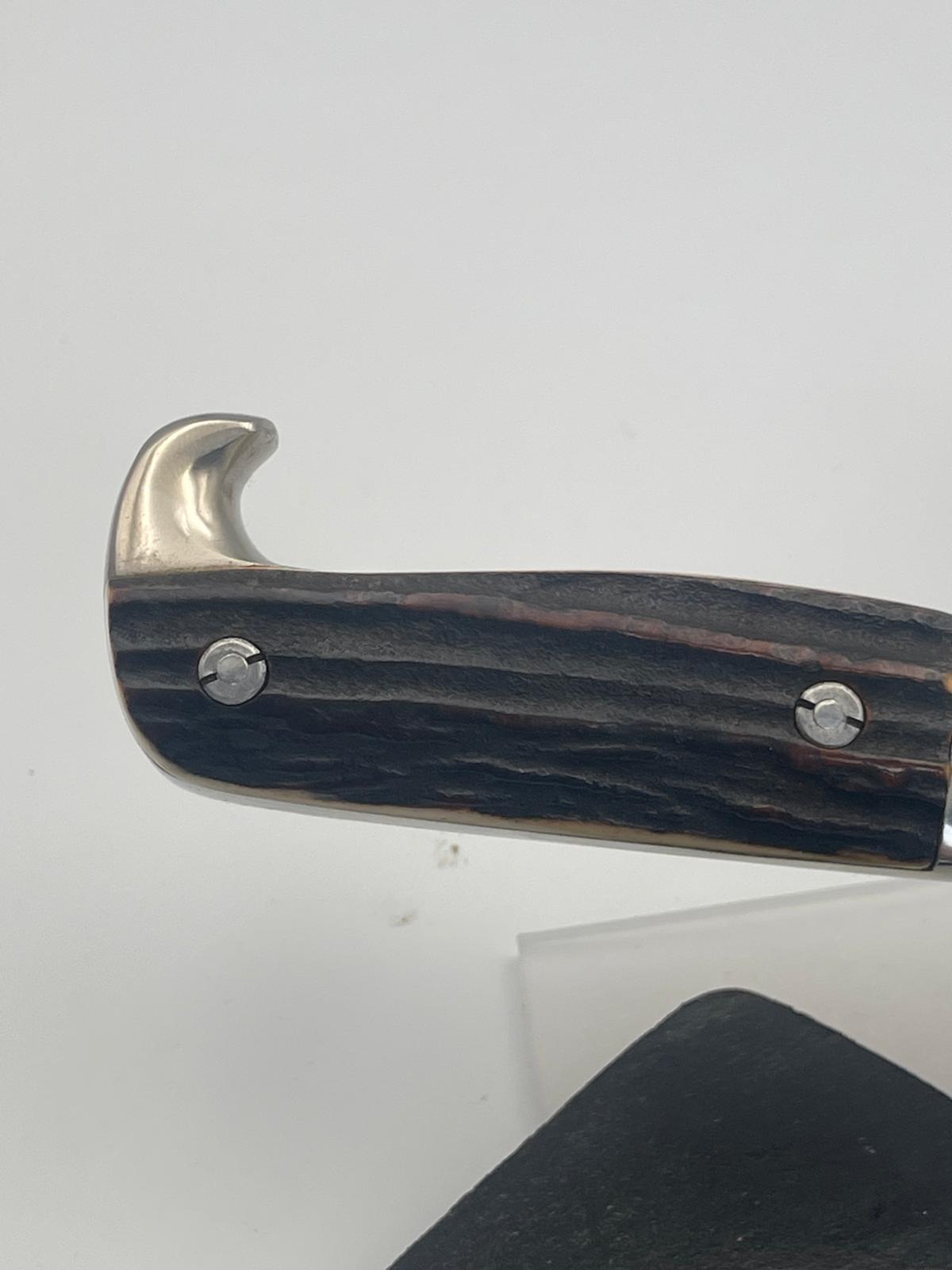
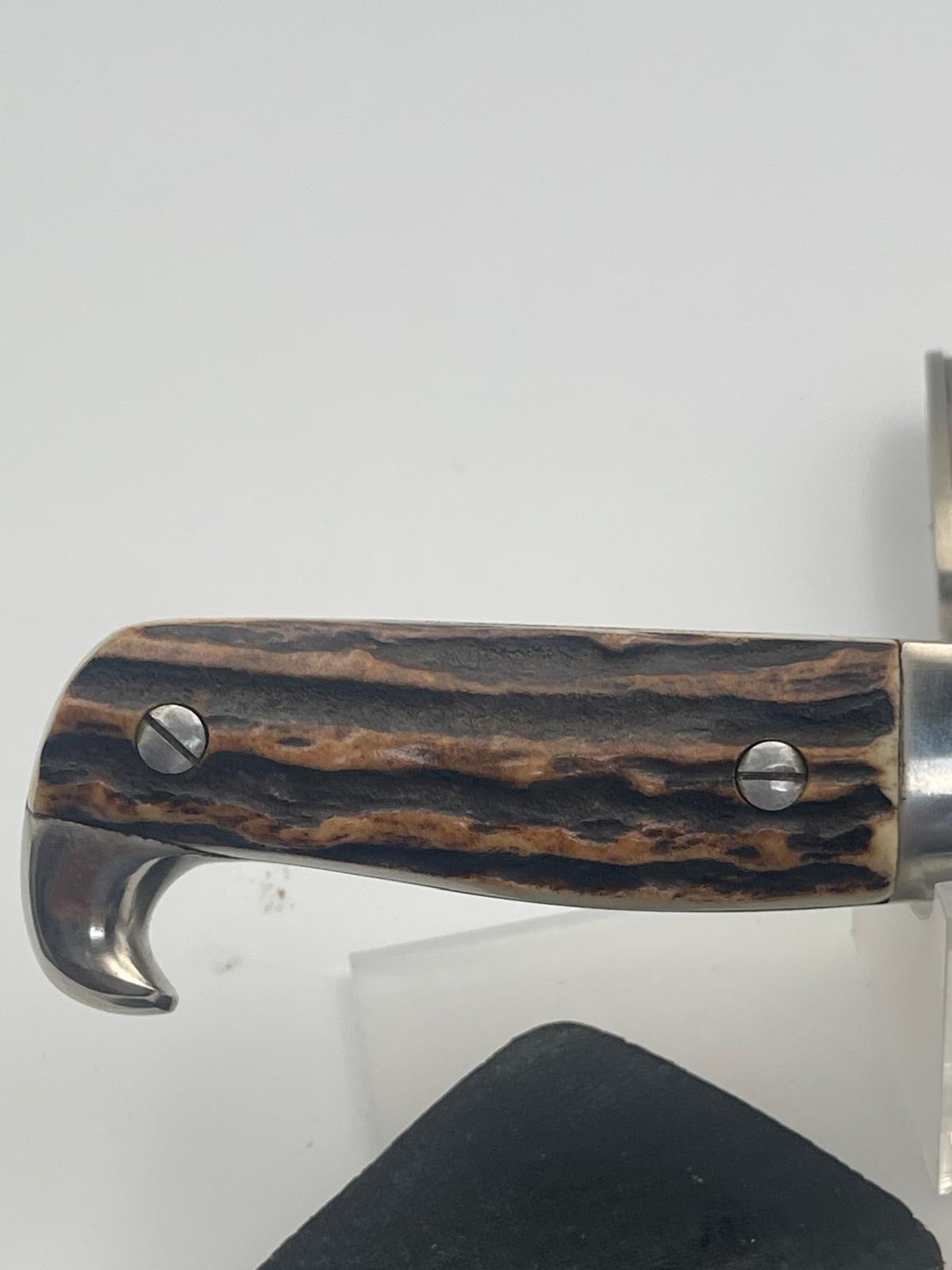
Two natural stag-horn grip plates form the handle.
Deep brown, tan and darker colouring runs through the antler surface. Each side displays the irregular ridges expected from genuine natural material.
Period-style slotted fasteners secure the grip plates.
Unlike the exceptionally rare earliest full-stag Eickhorn configuration, the present Wüsthof uses the standard later construction in which stag plates sit within the substantial metal hilt.
That distinction is important.
This should therefore be catalogued as an Ed Wüsthof M1934 RAD Mannschaften/Unterführer hewer with stag grips, not as a full-stag first-model Eickhorn.
The heavy hilt retains attractive silver-coloured fittings.
A broad metal section surrounds the upper grip before flowing into the distinctive hooked pommel.
At the blade end, the substantial guard terminates in the characteristic curled quillon.
The fittings display a pleasing mellow silver finish with minor handling marks.
Period Wüsthof examples are documented with early Neusilber, or nickel-silver, fittings. A particularly fine Wüsthof reference example is specifically described as retaining early nickel-silver mounts.
The present fittings appear entirely consistent with that early-quality construction from the supplied photographs.
The scabbard is particularly impressive.
A black lacquered steel body sits between two large silver-coloured decorative mounts.
The black finish remains substantially complete. Minor contact marks and isolated surface wear provide the expected evidence of age without seriously detracting from its presentation.
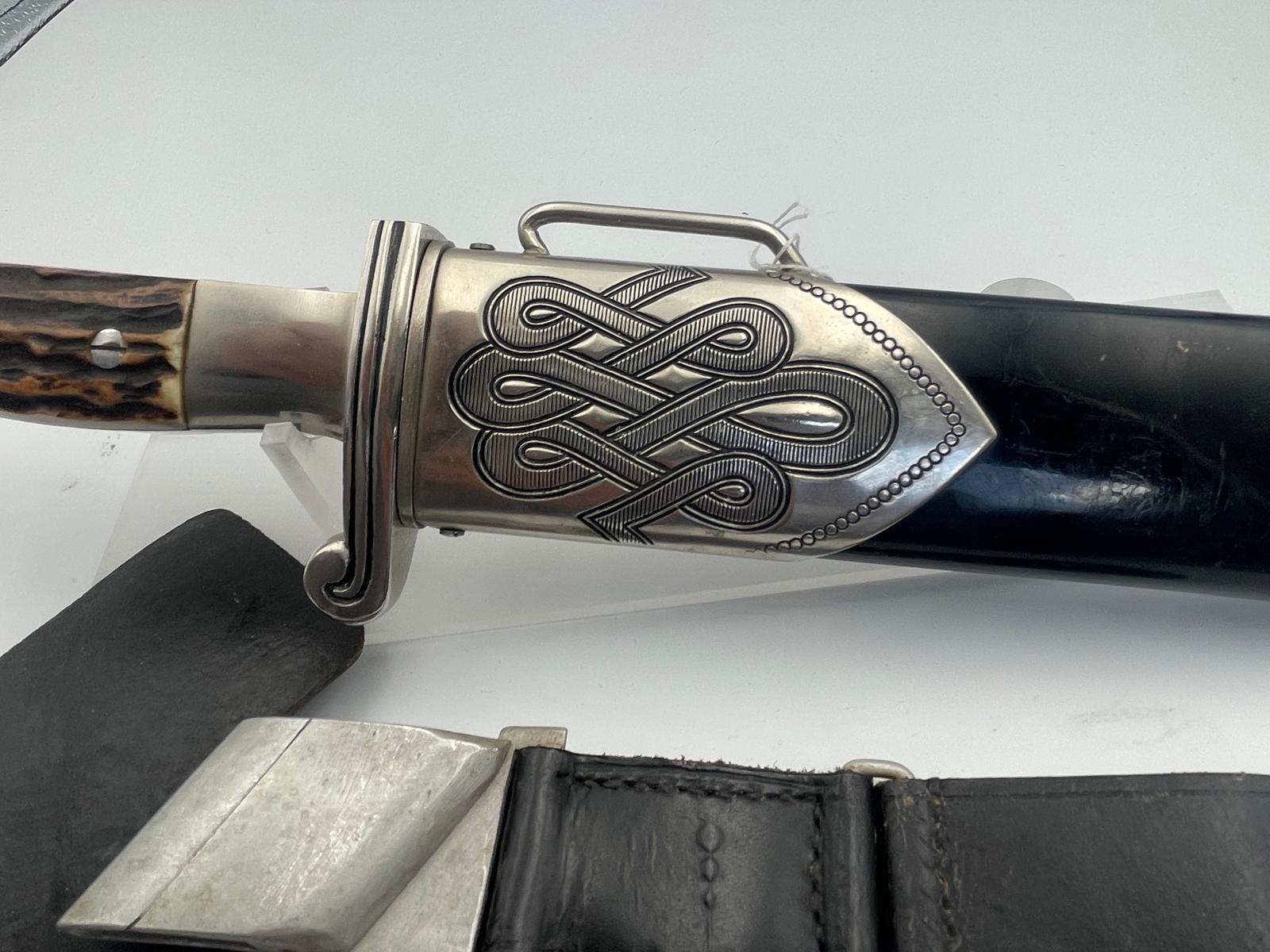
The large upper fitting carries the characteristic interwoven linear design.
Fine parallel engraving remains sharply defined throughout the ornament.
A beaded decorative border follows the lower edge.
The suspension bar remains securely positioned above the mount.
Its overall quality complements the substantial construction of the hewer itself.
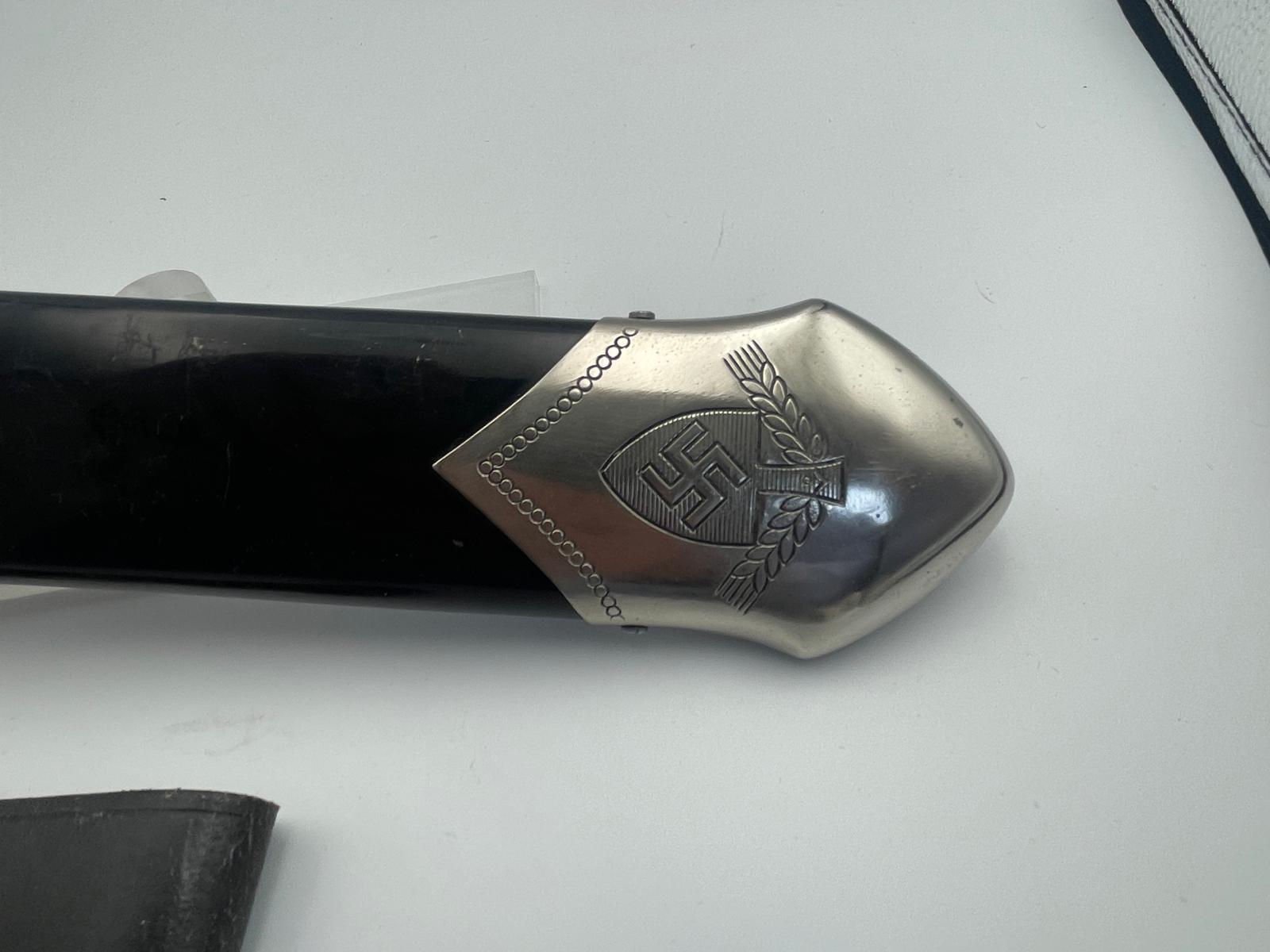
The lower fitting is dominated by the unmistakable RAD insignia.
A stylised spade containing the swastika sits between wheat or grain ears.
Fine vertical engraving remains visible within the spade field, while the surrounding agricultural motif retains excellent definition.
Another beaded border frames the upper section.
The large pointed shape of the lower mount gives the RAD hewer its unmistakable profile.
Importantly, the fitting does not show the severe dents, crushing or extensive plating loss frequently encountered on surviving examples.
A particularly valuable feature is the surviving black leather suspension hanger.
The hanger incorporates:
Original RAD hewer hangers are frequently missing.
Indeed, Ratisbon’s price archive records a standalone Assmann RAD hewer hanger selling for €625 during 2025, demonstrating how valuable correct suspension equipment has become independently of the hewer itself.
The present hanger therefore adds considerably to the completeness of this set.
No maker stamp can be read in the photographs supplied. Consequently, I would not attribute this hanger to Assmann or another manufacturer unless a mark becomes visible during physical inspection.
That conservative approach prevents an unsupported maker claim.
Photographic examination strongly supports an original pre-1945 Ed Wüsthof RAD Hewer.
Positive characteristics include:
A collector reference discussing another Ed Wüsthof RAD hewer similarly identifies maker-marked Wüsthof examples as desirable early pieces.
Furthermore, a specialist German dealer currently illustrates an early Wüsthof hewer carrying the same basic manufacturer and RADJ marking system.
No feature visible in these photographs presently causes concern regarding the period authenticity of the hewer.
Overall condition: Excellent collector condition.
The blade remains bright and exceptionally presentable.
Both the motto and manufacturer markings retain excellent definition. Only limited age and storage traces can be seen.
Natural stag remains complete and attractive.
No major crack or missing antler section appears in the supplied photographs.
The silver-coloured fittings remain exceptionally strong.
Light surface traces and evidence of historical cleaning are visible under close examination.
Much of the black finish survives.
Small scratches and minor wear remain visible, although the lacquer presents extremely well overall.
Both mounts remain crisp.
The engraved upper ornament and lower RAD emblem retain outstanding definition.
The leather remains structurally strong.
Normal creasing and age appear around the stitched sections and folds. Metal fittings show appropriate mellowing and surface wear.
Not every RAD hewer carries the same collector value.
Carl Eickhorn examples appear comparatively regularly. Wüsthof manufacture is significantly harder to find.
Current specialist material describes Ed Wüsthof as a very scarce manufacturer of this pattern.
Therefore, the combination of:
scarce Wüsthof manufacture + exceptional blade + excellent stag + clean scabbard + original-period hanger
places the present example above the ordinary RAD hewer market.
Recent auction evidence provides useful guidance.
Ratisbon’s price database records a Wüsthof RAD Unterführer hewer with hanger at €1,120 in 2026. The same archive records Eickhorn examples with hangers between approximately €1,175 and €1,620, depending on condition and configuration.
Auction prices, however, should not simply be copied into specialist retail pricing.
The present example offers particularly strong condition, exceptionally clear Wüsthof markings, an excellent motto, clean blade, attractive scabbard and surviving hanger.
For further comparison, a current German specialist dealer asks €6,490 for a rare Wüsthof hewer housed in a unique carved presentation case. Much of that premium clearly relates to the extraordinary presentation case rather than the hewer alone.
Accordingly, the present example sits comfortably between ordinary auction-grade examples and exceptional presentation ensembles.
| Market Level | Approximate Value |
|---|---|
| Auction expectation | €1,300–€1,700 |
| Advanced collector sale | €1,750–€2,200 |
| Specialist dealer retail | €2,350–€2,750 |
| Attribute | Description |
| Object | RAD Hewer |
| Model | M1934 |
| Organisation | Reichsarbeitsdienst |
| User class | Mannschaften / Unterführer |
| Manufacturer | Ed. Wüsthof |
| Location | Solingen |
| Maker emblem | Circular trident trademark |
| Blade inscription | Arbeit adelt |
| Inspection marking | Triangular RADJ |
| Additional marking | Ges. Gesch. |
| Blade | Heavy single-edged clipped-point blade |
| Grip | Natural stag-horn plates |
| Hilt | Early heavy silver-coloured fittings |
| Scabbard | Black lacquered steel |
| Upper fitting | Interwoven engraved decoration |
| Lower fitting | RAD spade, swastika and grain emblem |
| Suspension | Period black leather hanger |
| Condition | Excellent collector condition |
This Ed Wüsthof RAD Hewer should not be valued as a generic M1934 example.
Wüsthof production appears considerably less frequently than standard Eickhorn pieces. Furthermore, the photographs show an unusually attractive combination of clean blade, sharp motto, excellent manufacturer markings and strong stag-horn grip plates.
The scabbard also remains notably well preserved.
Finally, the surviving leather hanger adds an important component that is frequently missing from otherwise complete hewers.
For an advanced RAD or Third Reich edged-weapons collection, this represents a particularly attractive and increasingly difficult maker variation.
Explore related listings: RAD & TeNo Hewers; Nordmenn Militaria – Weapons Collection; Rare Eickhorn RAD Full-Stag Hewer with Two Hangers; RAD Leader’s Dagger Model 1937 with Original Double Hangers.
Deutsches Historisches Museum – Reichsarbeitsdienst History
This manufacturer’s own historical archive confirms Wüsthof’s long Solingen manufacturing history dating from 1814.
Wüsthof – Official Company History
Ratisbon’s provides useful recent auction results for RAD Mannschaften and Unterführer hewers, including Wüsthof examples with hangers.
Ratisbon’s – RAD Hewer Price Archive
These links give the listing a strong balance of historical authority, manufacturer history and market-reference material.
Yes. The construction and markings visible in the photographs strongly correspond with documented original Ed Wüsthof RAD hewers from the Third Reich period.
This is the heavy Model 1934 RAD Hewer for Mannschaften and Unterführer.
Ed. Wüsthof of Solingen manufactured it. The blade carries the firm’s circular trident trademark.
Yes. Wüsthof-manufactured RAD hewers occur considerably less frequently than standard Carl Eickhorn examples, and specialist dealers describe Wüsthof as a very scarce maker.
The German motto translates literally as “Work ennobles.”
The reverse blade carries the recognised RADJ triangular marking together with the Ges. Gesch. designation.
No. The grip uses genuine stag-horn plates mounted within the metal hilt. The exceptionally rare earliest full-stag configuration is principally associated with early Carl Eickhorn production.
Yes. A period black leather RAD hewer hanger accompanies the weapon.
No maker mark is visible in the supplied photographs. Therefore, the hanger should not presently be attributed to Assmann, HABRA or another maker without further evidence.