
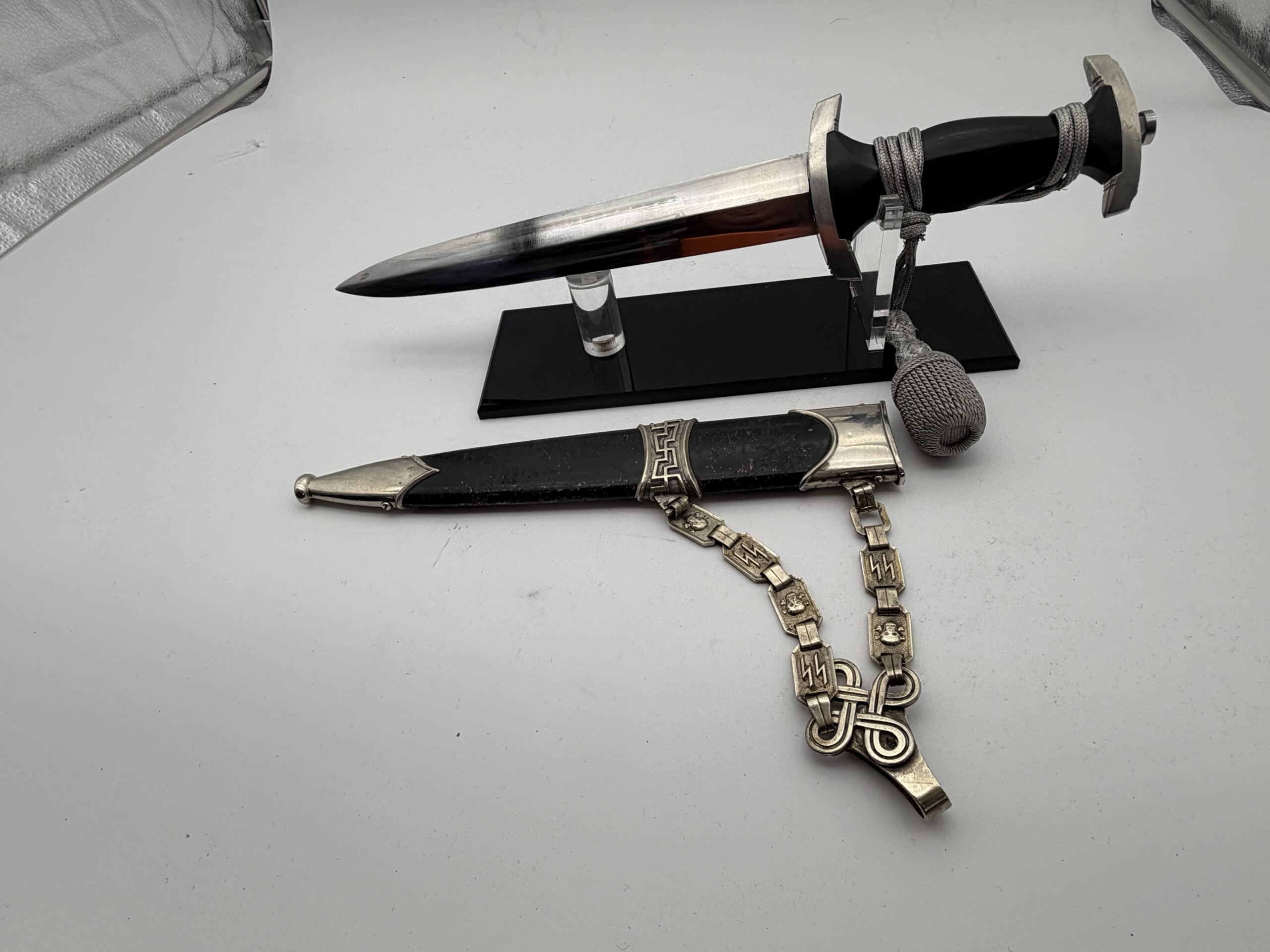
This M36 SS chained dagger is a highly collectable Model 1936 SS service dagger. It retains its black scabbard, complete articulated chain and silver-grey portepee. Moreover, the suspension displays alternating SS-rune and Totenkopf links.
€ 6.400
1 in stock
This M36 SS chained dagger is a highly collectable Model 1936 SS service dagger. It retains its black scabbard, complete articulated chain and silver-grey portepee. Moreover, the suspension displays alternating SS-rune and Totenkopf links.
The dagger has an apparently unmarked motto blade, black wooden grip and nickel-coloured fittings. Its scabbard also carries the distinctive decorative centre mount associated with the chained pattern.
Based on the supplied photographs, the dagger displays many characteristics associated with an original period assembly. However, final authentication should remain subject to direct physical inspection.
Collectors can compare this example with other original SS daggers and German edged weapons in the Nordmenn Militaria collection.
The Model 1936 dagger developed from the earlier Model 1933 SS service dagger. It retained the same basic hilt and blade form. However, it introduced a far more elaborate suspension system.
The new pattern used an articulated chain rather than the simpler leather hanger found on most Model 1933 daggers. It also featured a wide central scabbard fitting with interlocking swastika decoration.
The Imperial War Museums Model 1936 SS service dagger provides an important institutional comparison. The museum records a wooden grip, nickel mounts and the characteristic Model 1936 form. Its associated scabbard uses a chain decorated with alternating death’s-head and SS-rune links.
The M36 pattern formed part of the SS uniform system. Therefore, it must be interpreted within the wider history of that organisation. The United States Holocaust Memorial Museum’s history of the SS explains how the SS developed into a central instrument of Nazi policing, persecution and mass murder.
The double-edged steel blade has the standard spear-point profile. Its obverse carries the etched SS motto:
Meine Ehre heißt Treue
The inscription translates as “My Honour Is Loyalty.” The lettering remains dark and clearly visible against the polished blade surface.
The reverse ricasso appears to be unmarked. Unmarked blades are frequently encountered on purpose-produced M36 chained daggers. Indeed, several documented specialist examples also have unmarked blades with the same etched motto.
The blade has received noticeable polishing or cleaning. Consequently, much of the original fine transverse cross-grain appears reduced. Longitudinal marks and areas of uneven tone are also visible.
Nevertheless, the blade remains full length and visually impressive. The point also appears intact. Furthermore, the motto has avoided serious corrosion or complete loss.
The polished blade represents the main condition weakness. Therefore, no further cleaning should be attempted.
The shaped black grip appears to consist of genuine wood. It has the narrow-waisted profile associated with SS service daggers.
A circular enamelled SS runic emblem sits near the upper crossguard. Below it, an inset national eagle occupies the centre of the grip.
The eagle displays clear wing, wreath and feather detail. It now has a warmer tone than the surrounding fittings. However, this difference may result from wear to its original silvered finish.
The grip appears generally sound. No major structural crack is visible in the supplied photographs. Nevertheless, close inspection beneath the crossguards remains advisable.
For comparison, see the original SS Model 1933 dagger grip preserved in the Nordmenn collection. The earlier component shows the same basic combination of black wood, inset eagle and enamelled SS emblem.
The upper and lower crossguards retain the curved form associated with the SS dagger family. Their stepped outer ends remain clearly defined.
Both guards display an aged silver-grey surface. Small marks, scratches and darker areas appear throughout. However, the fittings remain structurally complete.
The exposed tang nut remains present above the upper crossguard. Furthermore, the hilt components appear closely fitted around the wooden grip.
The fittings should not be polished. Their existing patina forms part of the dagger’s historical appearance.
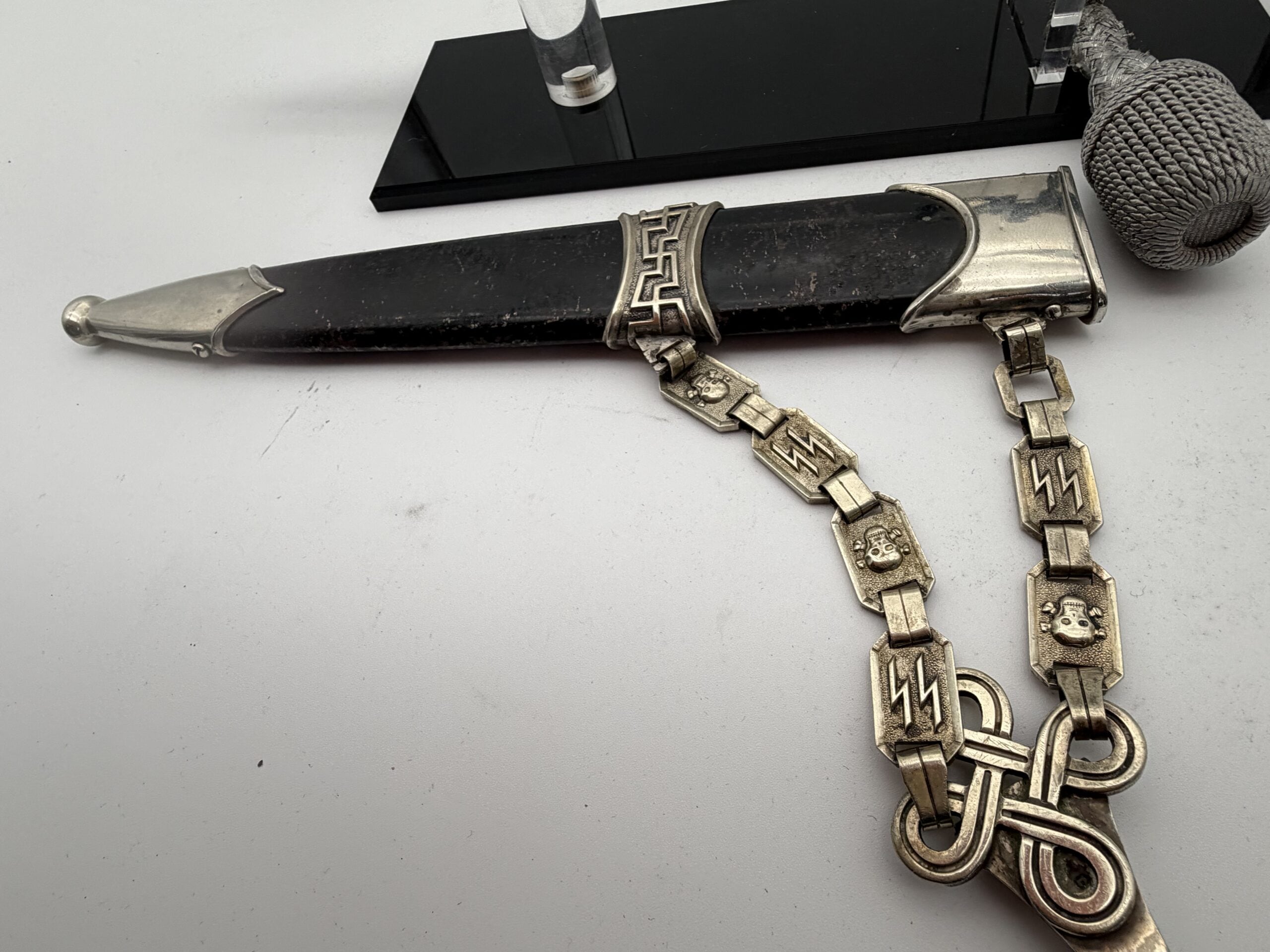
The articulated suspension forms the defining feature of this M36 SS chained dagger. It follows the recognised Type II or B-family configuration.
The shorter chain section carries two decorated plates. Meanwhile, the longer section has four. The plates alternate between raised SS runes and Totenkopf devices.
The chain includes:
The raised symbols retain good definition. In addition, darker patination survives within the recessed fields. Wear is concentrated on exposed edges and raised details.
This distribution appears consistent with prolonged handling. However, magnified examination remains necessary because modern copies can reproduce the basic link arrangement.
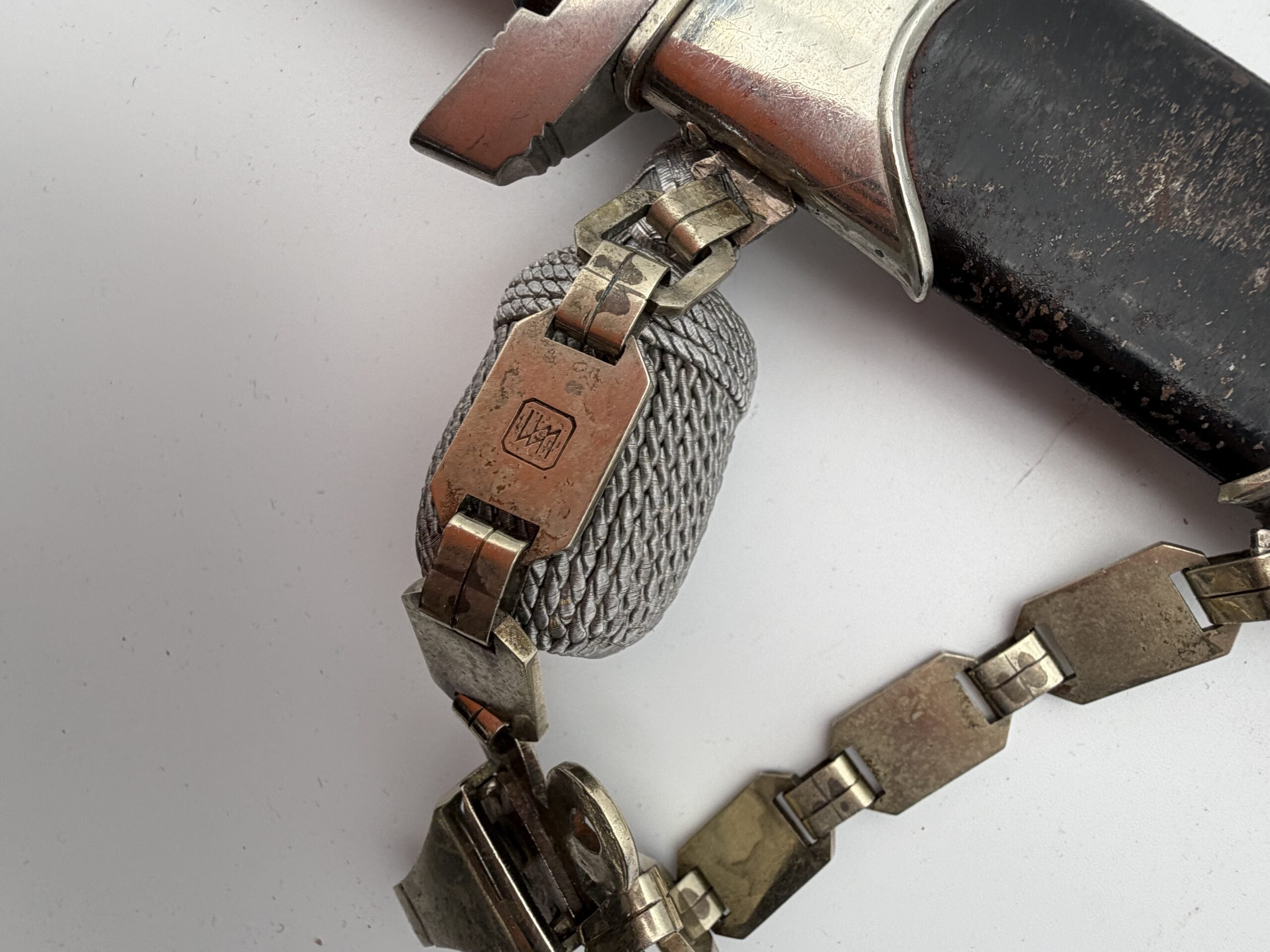
One reverse plate carries a boxed SS Kulturzeichen-style control mark. The stamp appears impressed into the metal rather than formed as part of a casting.
Specialist references divide Type II chains into several subtypes. Earlier versions commonly used nickel silver, while later examples employed plated steel. A magnet test would therefore help distinguish between B1 and B2 construction.
Until that test takes place, the safest catalogue identification is:
Type II or B-family M36 SS dagger chain, precise subtype unconfirmed.
The lower chain terminates in an ornamental interlaced clip. Collectors often call this form the Germanic knot, Wotan knot or cloverleaf clip.
Its openwork design remains well defined. The central loops also retain an aged finish consistent with the chain plates.
The rear spring and attachment system should be tested carefully. However, excessive pressure must be avoided because old spring components can fracture.
Documented original examples often carry additional markings inside the clip. Therefore, the interior should be photographed under strong, indirect light before listing.
The black steel scabbard retains its upper mount, central decorative fitting and lower chape. Its wide central mount distinguishes it from the simpler Model 1933 scabbard.
Interlocking swastika designs decorate the centre fitting. Raised borders surround the recessed and textured central field. The lower chain section attaches beneath this mount.
The scabbard has substantial age and service wear. Numerous abrasions and areas of finish loss appear on both faces. In addition, exposed metal and localised oxidation are visible along the edges.
Nevertheless, the body appears generally straight. The lower chape and rounded ball also remain present.
The worn finish gives the scabbard an honest, untouched appearance. However, the condition places it below examples retaining nearly complete black paint or anodising.
Collectors may compare its construction with the earlier Henckels Model 1933 SS dagger. That example illustrates the simpler two-mount scabbard used before the chained pattern.
A large silver-grey portepee is tied around the grip and lower crossguard. Its woven cord, stem and acorn-shaped knot remain complete.
The knot shows even ageing and some discolouration. Furthermore, the cord has localised fraying where it passes around the hilt.
The Imperial War Museums records an SS portepee constructed from aluminium thread with grey cross-hatched elements and black detailing. This provides useful institutional evidence for the materials used in original SS knots.
The portepee should still be authenticated separately. Ultraviolet examination, magnification of the weave and inspection of the internal filling would provide further evidence.
If confirmed as period original, it adds both visual interest and commercial value.
This M36 SS chained dagger survives in good, honest collector condition. It is not a mint or near-mint example. Instead, it shows extensive age, handling and storage wear.
Blade: Good. Strong motto and intact point. However, noticeable post-production polishing has reduced the original cross-grain.
Grip: Good to very good. The wooden grip appears sound, while both inset insignia remain present.
Hilt fittings: Good. Complete and naturally toned, with scratches and surface wear.
Chain: Good to very good. Complete Type II-style configuration with clear symbols and reverse control mark.
Scabbard: Fair to good. Structurally complete, although it has extensive black-finish loss and scattered oxidation.
Portepee: Good. Complete and attractive, with age toning and localised fraying.
Overall, the wear appears reasonably coherent across the dagger, scabbard and suspension. Therefore, the ensemble presents as a convincing period-used object rather than a recently assembled display piece.
Based on the supplied photographs, the construction of this M36 SS chained dagger is visually consistent with documented period examples.
Encouraging features include:
However, photographs cannot establish the alloy of the chain or confirm every internal component. They also cannot prove that all parts have remained together since the period.
The recommended commercial wording is:
Catalogued as an apparently original period M36 SS chained dagger with Type II chain and portepee. Final guarantee remains subject to direct physical examination and material testing.
Before sale, conduct a magnet test on the chain plates, connecting tabs, knot clip and scabbard fittings. In addition, inspect every retaining screw and photograph the blade under angled light.
The Model 1936 dagger remains one of the most recognisable objects associated with the SS uniform system. Its elaborate suspension and symbolic decoration give it considerable visual impact.
However, responsible cataloguing must include historical context. The SS controlled major areas of policing, intelligence and concentration-camp administration. It also played a central role in persecution, genocide and other crimes of the Nazi state.
This dagger should therefore be preserved as material evidence of dictatorship and political violence. Its inclusion in a collection does not represent approval of the organisation or its ideology.
Further institutional research can begin with the Imperial War Museums collection, the United States Holocaust Memorial Museum and the Bundesarchiv Invenio research system.
This M36 SS chained dagger combines several desirable features:
It would complement an advanced collection of SS daggers, Third Reich edged weapons or specialist SS uniform material.
A useful earlier comparison is the Gottlieb Hammesfahr Model 1933 SS dagger. Together, the two patterns illustrate the development from the original leather-suspended dagger to the later chained configuration.
Object: SS service dagger with scabbard and suspension
Model: Model 1936
German designation: SS-Dienstdolch M36 or SS-Kettendolch
Country: Germany
Period: Third Reich era
Blade: Double-edged steel
Blade inscription: Meine Ehre heißt Treue
Maker: No visible manufacturer’s mark
Grip: Shaped black wood
Grip insignia: SS runic roundel and national eagle
Fittings: Nickel-coloured metal
Scabbard: Black-finished steel with three decorative mounts
Suspension: Type II or B-family articulated chain
Chain decoration: Alternating SS runes and Totenkopf devices
Additional component: Silver-grey portepee
Condition: Good collectable condition with polishing and exterior wear